

A payment failure is rarely just a declined deposit. For an iGaming operator, it can mean an abandoned first session, a support ticket, a failed withdrawal expectation, or lost trust at the precise moment a player is ready to transact. That is why crypto payments vs fiat gaming rails is not a philosophical debate about payment preference. It is an infrastructure decision that affects acquisition, retention, risk exposure, reconciliation, and market expansion.
For operators building across jurisdictions, the strongest payment strategy is usually not choosing one rail over the other. It is designing a controlled payment layer that uses each rail where it delivers measurable commercial and operational value.
Crypto Payments vs Fiat Gaming Rails: The Core Difference
Fiat rails move value through established banking and card networks. Depending on the market, that can include card processing, bank transfers, open banking, e-wallets, prepaid methods, and local payment options. These rails are familiar to players, deeply tied to local currencies, and supported by mature fraud controls and consumer protections.
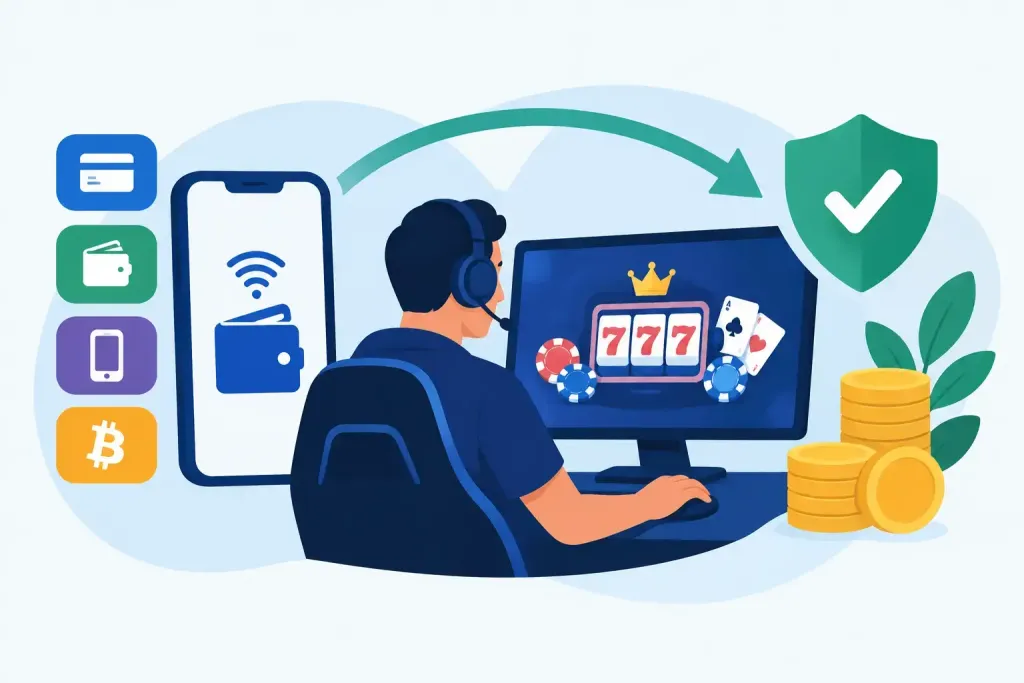
Crypto payment rails move value using digital assets and blockchain networks, often through wallets, payment processors, and conversion services. They can support rapid transfers across borders, operate beyond banking hours, and reduce dependence on traditional correspondent banking. For operators serving crypto-native audiences or markets with limited card acceptance, that can be a meaningful advantage.
The distinction matters because the rails create different operating models. Fiat payment flows are generally optimized for mainstream consumer behavior and localized compliance. Crypto flows are optimized for digital asset accessibility, cross-border movement, and potentially faster settlement. Neither is automatically better for every product, territory, or player segment.
Where Fiat Rails Remain the Operational Baseline
Fiat remains the default for many regulated gaming businesses because it matches how most customers receive income, hold funds, and manage daily spending. A player who sees their preferred card, bank transfer method, or local wallet at checkout experiences less friction than one asked to acquire, transfer, and understand a digital asset before placing a wager.
For an operator, fiat rails can also provide a clearer path to market-specific payment localization. Payment preferences vary sharply by country. Cards may dominate in one jurisdiction, while bank transfers, mobile wallets, or domestic schemes determine conversion in another. A platform that supports local methods can reduce unnecessary checkout abandonment without forcing a single payment behavior on every market.
Fiat is not frictionless, however. Card declines, processor restrictions, chargebacks, cross-border approval rates, withdrawal delays, and banking dependency all create real constraints. Gaming is frequently categorized as higher risk by payment institutions, which can raise processing costs and add underwriting complexity. An operator relying on one acquirer or one payment method creates a clear point of failure.
Chargebacks and Reconciliation Require Discipline
The apparent familiarity of fiat can obscure its back-office cost. Chargeback management requires evidence workflows, dispute monitoring, fraud review, and clear player communication. Deposit and withdrawal events may settle on different timelines, while fees can vary by method, region, currency, and processor.
A capable gaming payment architecture should normalize these transaction states in the back office. Finance, risk, customer support, and operations teams need a single view of pending, approved, reversed, declined, and disputed activity. Without that control, payment expansion can create more operational fragmentation than revenue.
Where Crypto Can Create a Strategic Advantage
Crypto can be commercially relevant when it serves a clear player demand or removes a genuine payment bottleneck. Crypto-native users may expect wallet-based deposits and withdrawals as a baseline. International audiences may value the ability to fund an account without navigating card limits, banking delays, or foreign exchange friction.
Settlement speed is a major consideration. A blockchain transaction can be confirmed quickly, though actual speed depends on the asset, network conditions, risk checks, and the operator’s internal processing rules. Faster movement of funds can improve the withdrawal experience, especially when the alternative involves multi-day banking windows.
Crypto rails can also broaden currency strategy. Rather than building separate banking relationships for every market at the outset, an operator may use digital assets as one component of an international payment model. That does not remove legal or compliance obligations, but it can reduce dependence on fragmented legacy rails when structured correctly.
Speed Does Not Eliminate Risk
The operational trade-off is that crypto introduces risks that a gaming business must actively manage. Wallet screening, source-of-funds controls, sanctions exposure, transaction monitoring, asset volatility, custody arrangements, and irreversible transfers require mature policy and technology.
Volatility deserves particular attention. If player balances, deposits, or liabilities are held in a fluctuating asset, the operator can take on avoidable market exposure. Many businesses address this by using immediate conversion rules, stable-value assets where appropriate, ledger controls, and defined treasury policies. The right design depends on licensing requirements, asset availability, and the operator’s risk appetite.
Crypto does not make compliance optional. In regulated markets, the question is not whether a transaction arrives on-chain or through a bank. The question is whether the operator can verify customers, monitor activity, retain required records, enforce responsible gaming controls, and meet the obligations of the relevant jurisdiction.
The Decision Should Start With the Market, Not the Technology
Payment selection should begin with commercial reality. Who are the intended players? Which jurisdictions are in scope? What payment methods do those users already trust? What does the licensing framework allow? How quickly must deposits and withdrawals clear? These questions are more useful than a generic preference for crypto or fiat.
A regulated, mass-market sportsbook entering a card-heavy jurisdiction may prioritize local fiat acquiring, bank transfers, and approved wallets. A casino brand targeting international, crypto-literate users may see a higher return from wallet support and stablecoin-based flows. A multi-market operator may need both, governed by market-specific rules rather than offered as an undifferentiated global menu.
The commercial objective should be conversion with control. More methods do not automatically improve performance if they create confusing checkout experiences, duplicate support cases, or difficult reconciliation. The best payment stack presents relevant options to the right users while keeping risk, compliance, and reporting centralized.
Build for Orchestration, Not a Single Rail
The long-term answer to crypto payments vs fiat gaming rails is payment orchestration. Operators need the ability to route transactions, manage providers, configure rules, and expose localized methods without repeatedly rebuilding the platform.
A unified payment layer should connect deposits, withdrawals, player wallets, bonus logic, KYC status, fraud signals, and back-office reporting. It should also support practical controls: transaction limits, approval workflows, automated reconciliation, provider failover, currency conversion settings, and clear audit logs.
This matters most when the business scales. A payment integration that works for one launch market may become a constraint when new currencies, local methods, processing partners, or regulatory requirements are introduced. Modular API-based architecture gives operators the flexibility to add or replace payment services without disrupting the player experience or rewriting core platform functions.
For platform owners, vendor consolidation is equally valuable. When payment data sits apart from player management, risk systems, and operational reporting, teams spend time reconciling exceptions rather than improving conversion. A connected back office gives decision-makers a clearer view of deposit success rates, withdrawal completion times, payment-method profitability, and risk patterns by market.
Design the Player Experience Around Trust
Players do not evaluate payment infrastructure the way technical teams do. They evaluate whether they can deposit quickly, whether their balance is correct, and whether withdrawals arrive when promised. Every payment choice should reinforce that trust.
That means clear currency display, transparent fees where applicable, realistic withdrawal messaging, consistent transaction statuses, and support teams that can identify the reason behind a payment event. For crypto, it also means clear wallet instructions and network selection safeguards. For fiat, it means minimizing unnecessary redirects, duplicate verification requests, and confusing declines.
Gameifylabs approaches payment capability as part of a broader operational stack: platform architecture, user management, secure transaction flows, multi-currency support, and back-office control must work together. Payment performance is not a standalone feature. It is a direct reflection of how well the gaming operation is engineered.
The practical next step is to map payment demand market by market, then test each rail against conversion, compliance, settlement, support workload, and total operating cost. Build a stack that can evolve as those inputs change. The operator that retains control of its payment layer is better positioned to enter new markets without letting payment complexity slow the business down.


DiscussionHave a technical perspective or question?Open discussion