
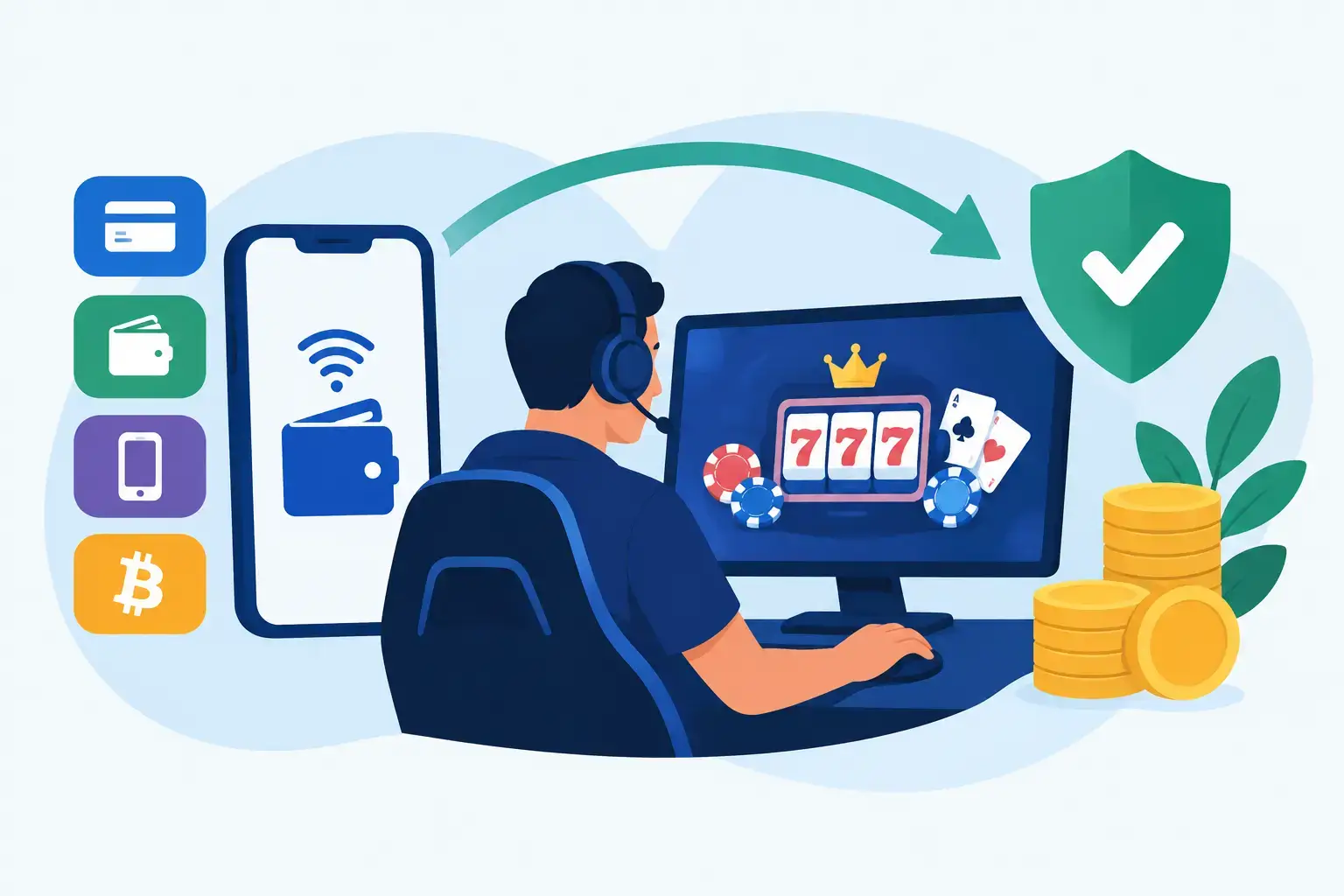
A failed deposit is rarely just a failed transaction. For an online casino or sportsbook, it can mean an abandoned registration, a frustrated VIP, a support ticket, or a player moving to a competitor. The question of which payments support gaming operators is therefore not answered by naming a single provider or method. It is answered by building the right payment mix for each market, player segment, and regulatory model.
Payment infrastructure sits at the intersection of conversion, compliance, fraud control, and cash-flow management. Operators need deposits that authorize reliably, withdrawals that reach players quickly, and controls that stand up to licensing scrutiny. The strongest approach is not to force every customer through one rail. It is to combine locally relevant methods behind a controlled, auditable payment layer.
Which payments support gaming operators in practice?
Gaming operators typically need support across five payment categories: card processing, bank-based payments, digital wallets, prepaid and voucher methods, and crypto or alternative digital assets where permitted. Each category solves a different operational problem, and each carries distinct approval, settlement, compliance, and integration requirements.
Debit and credit cards remain essential in many markets because players recognize them and can use them immediately. Their weakness is gaming-specific issuer decline rates. Some banks restrict gambling transactions, while card schemes and acquirers apply stricter monitoring to high-risk merchant categories. A card processor with iGaming underwriting experience, appropriate merchant category configuration, fraud tooling, and regional acquiring relationships is materially more valuable than a generic checkout provider.
Bank transfer methods can improve both trust and economics. Open banking payments, instant account-to-account rails, direct debit, and local bank transfer options often produce lower processing costs than cards and can reduce false declines. They are particularly effective in markets where bank authentication is familiar to consumers. The trade-off is that the payment experience and settlement timing vary by country, while withdrawal workflows may require more account validation.
Digital wallets are often the conversion layer that cards cannot provide. Players may prefer wallets because they limit direct exposure of banking details, accelerate checkout, and support repeat deposits with less friction. In markets where a wallet has strong consumer adoption, excluding it can weaken acquisition performance. Operators must still confirm whether the wallet permits gaming transactions in the relevant jurisdiction and whether its rules support the intended deposit and payout flow.
Prepaid vouchers, cash-to-digital options, and mobile payments remain relevant for markets with lower card penetration, strict banking preferences, or a sizable cash-oriented audience. These methods can widen reach, but they may complicate player verification and withdrawal routing. A deposit method that cannot support a practical payout path should be designed into the cashier with clear controls, not treated as a standalone acquisition shortcut.
Crypto can be useful for operators licensed in jurisdictions where it is permitted and where the risk framework is mature. It can support cross-border access, faster settlement, and multi-currency strategy. It also creates additional exposure around wallet screening, source-of-funds checks, exchange-rate management, transaction monitoring, and jurisdictional restrictions. Crypto readiness is a platform capability, not a substitute for regulatory discipline.
Payment choice depends on the market, not the logo
The right payment stack changes when the operating market changes. A method with excellent approval rates in one country may be unfamiliar, unavailable, or restricted in another. Local payment preference is not a cosmetic checkout decision. It directly affects first-deposit conversion and player confidence.
A US-facing sportsbook may prioritize regulated card acquiring, ACH-based options, online banking, and approved wallets, with geolocation and state-specific rules built into the transaction flow. A European operator may require open banking, local transfer schemes, wallets, and stronger customer authentication handling. A multi-market brand may need dozens of local methods while maintaining a single view of balances, reconciliation, risk, and reporting.
This is why operators should evaluate payment coverage by corridor rather than by provider count. Ask practical questions: Can the method accept deposits from the target player base? Does it support withdrawals? What are typical authorization and settlement outcomes for licensed gaming merchants? Is it approved for the operator’s license and jurisdictions? Can it be configured by brand, country, currency, and player risk tier?
The objective is a cashier that feels local to the player while remaining centrally governed by the operator.
Deposits and withdrawals must work as one system
Many payment projects overemphasize deposits because they are visible at acquisition. That creates downstream friction when players request a payout. Fast, transparent withdrawals are a commercial advantage in iGaming, but they must be balanced against fraud prevention, responsible gaming controls, bonus abuse checks, and anti-money laundering obligations.
Whenever possible, operators should support payout to the original funding method or a verified account linked to the player. This reduces payment diversion risk and makes reconciliation clearer. Where a method is deposit-only, the platform needs defined fallback payout routes and rules for collecting the necessary account details without interrupting the player experience.
Withdrawal automation should never mean uncontrolled release of funds. A mature payment module applies configurable thresholds, identity status checks, velocity controls, device and behavioral signals, bonus wagering validation, and manual-review queues. Low-risk withdrawals can move quickly, while exceptions are routed to operations teams with the evidence they need to act.
Compliance and risk controls are part of payment support
A payment method is not operationally viable simply because its API is available. Gaming transactions must be supported by the operator’s licensing conditions, the payment provider’s acceptable-use policy, and applicable rules for KYC, AML, sanctions screening, consumer protection, and data security.
The platform should keep an auditable record of payment attempts, authorizations, reversals, chargebacks, payout approvals, and risk decisions. It should also support configurable limits by jurisdiction, currency, payment method, and player status. Deposit limits, cooling-off rules, self-exclusion flags, and affordability-related checks need to influence payment availability where regulations require it.
Data protection matters just as much. Operators should minimize direct handling of sensitive card data, use tokenization where available, and ensure that payment integrations are designed around appropriate PCI DSS responsibilities. The more fragmented the payment estate becomes, the harder it is to maintain clear ownership of security events, reconciliations, and compliance evidence.
Fraud strategy also requires nuance. Aggressive decline rules can block legitimate players and suppress revenue. Loose rules invite card testing, account takeover, friendly fraud, and bonus abuse. The right balance comes from layered controls: velocity checks, device intelligence, IP and geolocation signals, payment instrument reputation, transaction monitoring, and risk rules that can be tuned by market and player value.
Build a payment architecture that can scale
Operators should avoid hard-coding commercial decisions into individual payment integrations. Payment availability changes. Providers enter and exit markets, issuers alter gambling policies, regulatory requirements evolve, and approval rates fluctuate. A scalable architecture treats payment methods as configurable modules connected through a unified orchestration and back-office layer.
That layer should route transactions based on country, currency, method availability, processor performance, player history, and risk policy. It should also provide real-time visibility into approval rates, drop-off points, payout aging, chargebacks, and reconciliation exceptions. Without this operational view, teams discover payment problems only after revenue has already been lost.
A unified API approach reduces the cost of adding or replacing providers and keeps the front-end cashier independent from the complexity underneath. It also gives product, finance, risk, and customer support teams a shared operational record instead of separate provider dashboards. For operators launching across multiple brands or regions, that control is often the difference between expansion and integration debt.
Gameifylabs approaches payments as part of the wider iGaming infrastructure stack: configurable gateway capabilities, multi-currency and crypto-ready modules, back-office controls, and the integration foundation required to manage growth without multiplying operational silos.
How to evaluate a payment partner for iGaming
The best partner is not necessarily the one with the longest payment-method list. It is the one that can prove support for your licensed markets, commercial model, currencies, and risk posture. Request market-level performance data where possible, including authorization rates, payout times, chargeback handling, and onboarding requirements for gaming merchants.
Assess the integration model with equal care. A fast API is useful, but operators also need reliable webhooks, idempotent transaction handling, clear error codes, reconciliation files, sandbox environments, role-based back-office access, and responsive incident support. Payment outages and duplicate transaction errors are operational incidents, not minor technical defects.
Finally, test the player journey under real conditions. Review mobile checkout, authentication prompts, failed-payment recovery, deposit limits, verification triggers, cancellation flows, and withdrawal messaging. The payment experience should make the next correct action obvious to the player while keeping the operator in control.
The most effective gaming payment strategy is built for change. Start with the methods your target market trusts, connect them through infrastructure that can enforce policy and expose performance, then expand based on verified player behavior rather than assumptions. That is how payment support becomes a growth engine rather than another fragmented vendor problem.



DiscussionHave a technical perspective or question?Open discussion