

A new casino or sportsbook rarely loses momentum because the brand concept is weak. It loses momentum when content providers, payment services, player accounts, compliance workflows, and reporting systems are connected through separate vendors with separate priorities. An api first gaming platform changes that operating model by making integration the foundation of the product rather than an afterthought.
For operators entering competitive or regulated markets, this is not simply an architectural preference. It affects launch timelines, supplier onboarding, operational visibility, and the cost of expanding into new jurisdictions. The right API strategy gives teams a controlled way to add capability without repeatedly rebuilding the platform around it.
What an API First Gaming Platform Changes
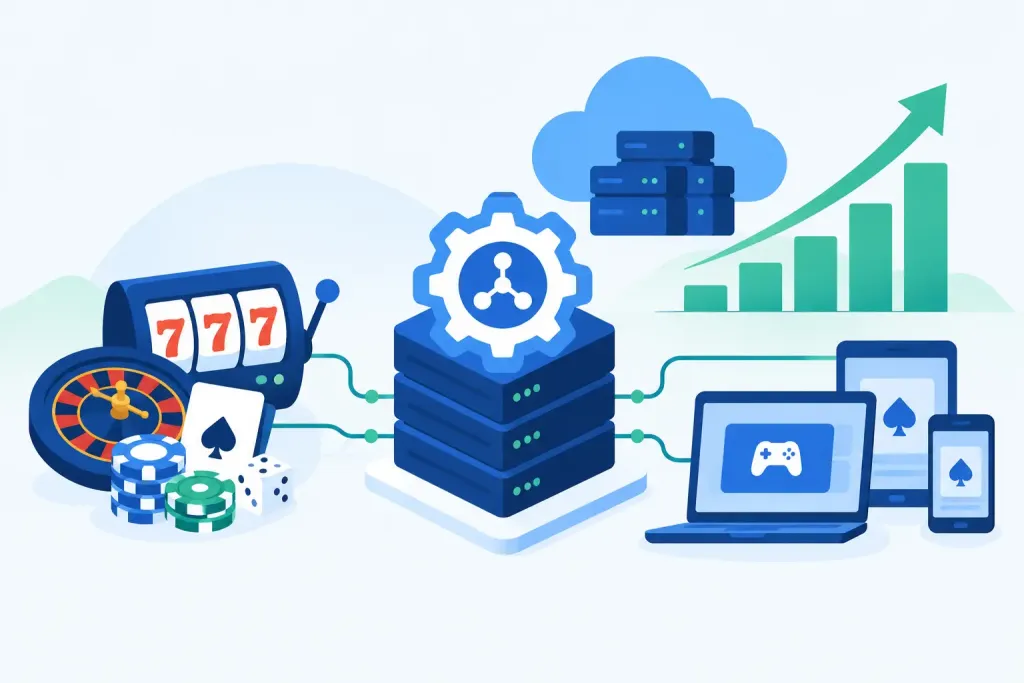
An API-first platform is designed so that its primary functions can be accessed, managed, and extended through documented application programming interfaces. In iGaming, that means the systems behind player registration, wallets, game launches, betting activity, bonuses, payments, reporting, and back-office administration are built to exchange data predictably.
This matters because an operator does not run a single product forever. A casino may begin with slots and table games, then add live casino, sportsbook, crash games, jackpot campaigns, crypto payment options, or localized cashier methods. Every expansion introduces new data flows and operational requirements. If the platform was built around isolated modules or custom point-to-point connections, each addition can create another maintenance burden.
With an API-first architecture, the platform establishes consistent rules for how services communicate. Product teams can use standardized endpoints, authentication methods, data structures, and event handling instead of inventing a new integration pattern for every provider. That reduces technical friction, but the larger value is control. Operators can make commercial decisions faster because the technology is ready to support them.
Integration Speed Is a Commercial Advantage
Speed to market is often discussed as a launch-date metric. In practice, it is a continuing advantage. The first launch matters, but so does the ability to respond when a payment method becomes essential in a target market, a top-performing supplier needs to be added, or a regulatory change requires updated verification logic.
A unified API reduces the number of independent integrations the operator must manage. Instead of connecting directly to every game studio, sportsbook feed, payment provider, and supporting service, the business can work through a consolidated infrastructure layer. This shortens implementation cycles and creates a clearer ownership model when issues occur.
The trade-off is that not every API aggregation model provides the same depth of control. Some platforms expose only basic content access, while others support configuration across wallets, limits, player segments, promotional tools, reporting, and jurisdiction-specific settings. Decision-makers should evaluate more than the number of suppliers listed in a catalog. They should determine whether the API supports the workflows their operations team will need six months after launch.
Content aggregation without operational fragmentation
Game content is a core acquisition and retention lever, but connecting to a large provider portfolio can become technically expensive. Each direct integration may introduce unique certification requirements, game launch parameters, wallet behavior, promotional rules, and reporting formats. Those differences accumulate quickly.
An API-first gaming platform provides a common integration layer for aggregated casino content and, where relevant, sportsbook services. The operator receives a more consistent way to manage game availability, lobby placement, supplier activation, and transaction data. This is particularly valuable for multi-brand businesses, where separate front ends may need different content strategies while operating on shared infrastructure.
Content breadth alone is not enough. Operators need to know which games are available by territory, currency, device type, and regulatory status. A platform that handles these controls centrally helps prevent avoidable exposure, such as presenting unavailable content to players in a restricted market.
Payments become part of the platform strategy
Payment localization is another area where fragmented technology creates risk. A payment method can be popular with players yet difficult to operate if deposits, withdrawals, fraud checks, currency conversion, and reconciliation are handled across disconnected systems.
API-driven payment infrastructure allows the cashier experience to connect directly with player wallet logic and back-office controls. Deposits, withdrawals, account limits, transaction statuses, and risk signals can move through a defined operational flow rather than being reconciled manually after the fact. Multi-currency support and crypto-ready modules can be significant advantages, but only when they are matched to licensing requirements, internal risk policies, and the markets being served.
The objective is not to offer every payment option available. It is to offer the right payment mix with reliable transaction handling, appropriate security controls, and clear financial reporting.
The Architecture Behind Scale
Growth creates load in more places than the game lobby. A successful operator must handle concurrent sessions, real-time wallet updates, betting or gaming transactions, provider callbacks, promotional activity, customer support actions, and compliance checks. A platform may perform well under ordinary traffic yet fail when a major event, affiliate campaign, or jackpot promotion drives concentrated demand.
API-first design supports scale by separating services and defining how they interact under pressure. It makes it easier to monitor performance, isolate failures, and update individual components without placing the entire product at risk. This does not eliminate the need for capacity planning. It does give technical teams a better foundation for it.
Enterprise-grade stability depends on more than API documentation. Operators should assess uptime targets, transaction idempotency, error handling, monitoring, logging, backup procedures, and incident response. If a network interruption causes a payment request or game round callback to be sent twice, the platform must process that event safely. Small details in transaction design protect both player trust and operator revenue.
Back-office control should not be an afterthought
The player-facing experience gets attention, but back-office capability determines how effectively a business can run at scale. Operations teams need a central view of player profiles, wallet activity, verification status, bonuses, limits, support actions, and reporting. Without it, teams resort to spreadsheets, manual reconciliations, and separate provider dashboards.
A capable API-first platform connects the operational layer to the same core data model used by the customer experience. That gives authorized teams the ability to manage accounts, investigate transactions, configure campaigns, and act on risk signals with current information. Role-based access controls are essential here. Not every employee should be able to change wallet settings, alter player limits, or access sensitive personal data.
For platform owners supporting multiple operator brands, centralized back-office management also creates a practical balance between shared efficiency and brand-level independence. Each brand can maintain its own configuration, reporting views, and commercial strategy while relying on a common technology base.
Security and Compliance Need API-Level Discipline
In iGaming, security cannot be added at the user interface. APIs move high-value data and financial instructions between services, making them a central security boundary. Authentication, authorization, encryption, rate limits, audit trails, and secure key management must be designed into the infrastructure from the beginning.
Compliance requirements vary by jurisdiction, and an API-first model does not remove that complexity. It can make compliance work more manageable when required controls are configurable and traceable. Operators may need to enforce deposit limits, self-exclusion rules, identity verification, geographic restrictions, reporting obligations, or particular data retention policies. The platform should make those requirements operationally possible without forcing a new development project for every market change.
Certification also deserves careful attention. A supplier may describe its software as certified, but operators should confirm what has been tested, for which markets, and how certification responsibilities are divided between the platform, content providers, and the operator. The commercial value of speed disappears if licensing or technical approval becomes a late-stage surprise.
Choosing the Right API-First Partner
The strongest platform choice is not necessarily the one with the longest feature list. It is the one that reduces dependency while preserving the controls that matter to the business. Operators should examine whether the provider can support their launch model, target jurisdictions, payment needs, content roadmap, and expected transaction volumes.
Technical stakeholders should ask how the API handles versioning, documentation, sandbox access, webhooks, service-level commitments, and support escalation. Product leaders should ask how quickly new suppliers, currencies, or brands can be activated. Operations leaders should ask whether reporting and user management support the realities of fraud prevention, customer service, finance, and responsible gaming.
A turnkey solution can be the right choice when speed and vendor consolidation are priorities. A more customized deployment may be justified when an established operator has specialized workflows, proprietary player engagement systems, or market-specific requirements. The deciding factor is not whether a solution is turnkey or custom. It is whether the underlying architecture allows the business to evolve without creating a new integration problem at every stage.
Gameifylabs approaches this challenge with unified API connectivity, aggregated gaming access, payment infrastructure, and back-office capabilities designed for operators that need execution as much as ambition. The goal is not merely to connect systems. It is to give gaming businesses the infrastructure to launch with confidence and expand with operational control.
The operators that move fastest over time are not those that add the most vendors. They are the ones that build on a platform where each new market, payment method, and content decision strengthens the business instead of complicating it.


DiscussionHave a technical perspective or question?Open discussion