

A content roadmap can determine whether an online casino launches in months or spends that time negotiating contracts, building integrations, and resolving certification dependencies. The aggregator model vs direct game deals decision is not simply a commercial preference. It affects release velocity, supplier coverage, technical workload, operating margins, market access, and the level of control an operator retains as it scales.
For operators building a new brand or modernizing an existing platform, the right answer is rarely ideological. Direct supplier relationships can create strategic advantages. Aggregation can eliminate fragmentation and accelerate deployment. The strongest choice depends on where the business is today, where it plans to operate, and which capabilities it must own internally.
What the Aggregator Model Delivers
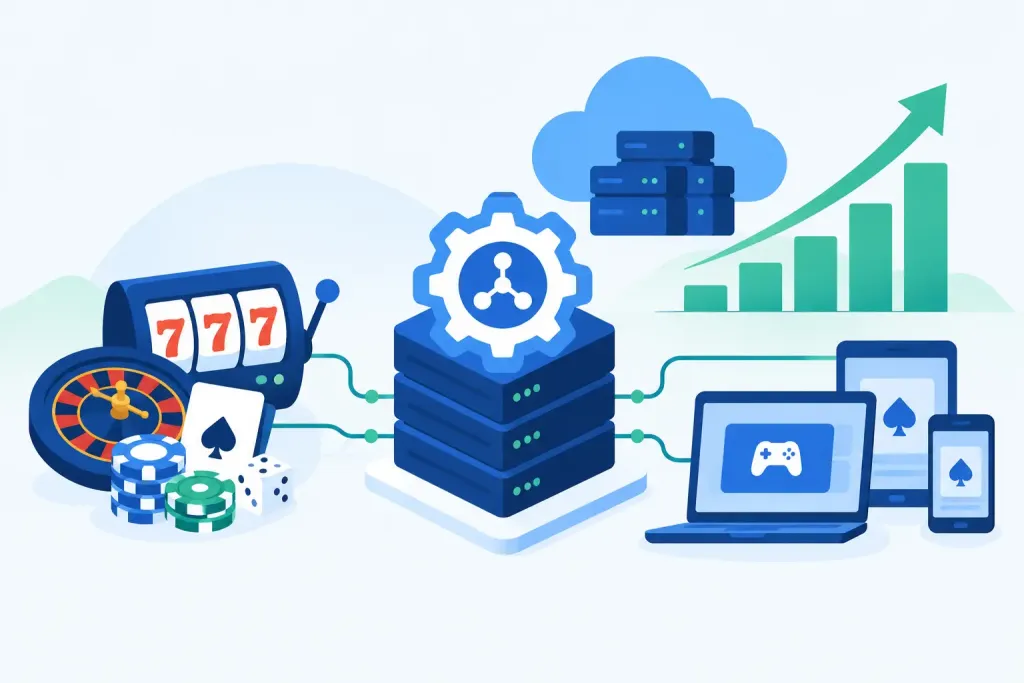
Under an aggregator model, an operator connects to one technical integration layer that provides access to multiple game studios and content catalogs. Instead of building and maintaining separate APIs for each provider, the operator manages a unified connection, typically supported by centralized game configuration, reporting, wallets, promotional mechanics, and back-office workflows.
The operational value is immediate. One integration can open access to slots, live casino, table games, instant-win content, crash games, and specialty titles from a broad supplier network. This reduces the time between platform readiness and a competitive content launch, particularly when a product team needs a credible lobby from day one.
Aggregation also limits integration debt. Every direct provider connection introduces unique technical documentation, game launch parameters, callback behavior, certification requirements, release schedules, and support procedures. Those differences are manageable for a mature organization with dedicated integration and QA resources. They become a drag when a lean team is trying to launch across several jurisdictions while also building payments, CRM, responsible gaming controls, and customer operations.
A well-designed aggregation layer standardizes much of that complexity. It can provide consistent API behavior, normalized game metadata, consolidated reporting, unified wallet operations, and a single operational escalation path. For platform owners, this means fewer vendor relationships to coordinate and a cleaner foundation for expansion.
Aggregator Model vs Direct Game Deals: The Core Trade-Off
The central trade-off is breadth and speed versus direct commercial control. Aggregation gives operators efficient access to a wide content portfolio through a single relationship. Direct deals give them a closer connection to individual studios, often with greater scope to negotiate commercial terms, access exclusives, and shape joint promotional activity.
Neither model is inherently superior. An early-stage operator entering a competitive market may benefit more from broad, ready-to-deploy content than from spending months negotiating with a small number of premium suppliers. A large, established casino brand with predictable volume and a proven acquisition engine may have the leverage and internal capability to make direct agreements commercially worthwhile.
Decision-makers should evaluate the model against total operating cost, not only headline revenue share. A direct deal may appear less expensive per game round, but its full cost includes legal review, technical development, testing, certification coordination, release management, reconciliation, reporting, and supplier support. Multiply that workload across ten or twenty providers, and the apparent savings can narrow quickly.
Conversely, aggregation fees may be justified when they replace substantial engineering and operational overhead. The commercial question is whether the aggregator’s margin is lower than the cost, risk, and lost time of independently managing a fragmented supplier stack.
Where Direct Deals Create Real Value
Direct game deals are most effective when an operator has a clear strategic reason to prioritize particular studios. That reason might be access to a market-leading game portfolio, early access to new releases, regional content strengths, custom campaigns, or exclusive commercial arrangements that cannot be obtained through a standard aggregated catalog.
A direct relationship can also improve visibility into a provider’s product roadmap. For mature operators, this can support stronger lobby planning, coordinated launch campaigns, and closer alignment between supplier content and player segmentation. If a studio consistently drives high-value player activity, deeper commercial collaboration can be justified.
There can be meaningful margin opportunities as well. Operators with significant volume may negotiate improved commercial terms directly, especially when they can offer distribution across multiple brands or regulated markets. But volume matters. Suppliers reserve their strongest terms and operational attention for partners that can deliver measurable scale, reliable compliance processes, and an established distribution strategy.
Direct connections require discipline. Each integration must be assessed for API quality, wallet architecture, reporting granularity, incident response, uptime history, versioning practices, game certification status, and jurisdictional readiness. A provider’s content may be excellent, but a weak technical or support model can create player-facing issues that undermine the operator’s brand.
The Hidden Cost of Content Fragmentation
Fragmentation is often underestimated during procurement. The first few direct integrations may seem manageable. Complexity rises sharply as suppliers are added, regulations change, and the business expands into new territories.
A fragmented ecosystem can produce duplicate data formats, inconsistent bonus behavior, separate dashboards, incompatible promotional tools, and difficult reconciliation processes. Product teams may struggle to maintain consistent lobby rules and game categorization. Operations teams may need to investigate incidents across several support channels. Finance teams may spend more time reconciling supplier statements and gaming activity.
There is also a customer experience impact. If game sessions, balances, or promotional features behave differently across providers, players notice. Technical inconsistency does not remain a back-office issue for long. It reaches support queues, retention metrics, and ultimately revenue.
This is why a single API strategy is not only about development efficiency. It is a control mechanism for the entire operating model. Standardized content delivery makes it easier to apply common rules, monitor performance, manage exposure, and respond quickly when a supplier issue emerges.
Compliance and Market Expansion Change the Equation
Regulated expansion makes supplier management more complex. Content availability, game certifications, technical controls, reporting obligations, and responsible gaming requirements differ by jurisdiction. An operator must know not only whether a game is available, but whether it is approved for the specific market, platform configuration, and player segment involved.
An aggregator with established supplier coverage and market-ready infrastructure can reduce the coordination burden. It can also provide a more efficient route to introducing content in new territories, provided its catalog and compliance posture align with the operator’s licensing strategy.
Direct contracts can still make sense in highly regulated markets where the operator needs close control over supplier approvals, bespoke integrations, or local commercial arrangements. The key is to avoid assuming that direct access automatically means faster access. In many cases, the added technical and certification work extends the launch path.
Operators should ask practical questions during due diligence: Which games are certified in each target market? How are restricted titles controlled? What reporting data is available? How quickly can game availability be changed? Who owns incident coordination? These answers matter more than the size of a catalog on a sales sheet.
A Hybrid Strategy Often Produces the Best Outcome
For many serious gaming businesses, the most effective approach is hybrid. Use aggregation as the core content foundation, then establish direct partnerships where the commercial or strategic case is proven.
This model protects speed to market while leaving room for differentiated supplier relationships. An operator can launch with a broad portfolio, test player demand, identify the studios that deliver sustained value, and pursue direct terms selectively. It avoids the risk of making large integration commitments before the data supports them.
A hybrid architecture must be planned carefully. The platform should maintain consistent wallet behavior, player session management, reporting, game discovery, and responsible gaming controls regardless of whether content arrives through an aggregator or a direct supplier connection. Without that discipline, the operator can recreate the same fragmentation it intended to avoid.
Gameifylabs supports this type of operating model through unified API infrastructure, scalable back-office capabilities, and aggregated content access designed for operators that need performance without unnecessary vendor sprawl. The objective is not to force every content relationship through one commercial structure. It is to give operators the technical control to make the right commercial choices as their business evolves.
Choosing the Right Model for Your Operating Stage
A launch-focused operator should prioritize time to market, catalog breadth, technical simplicity, and dependable support. Aggregation is usually the stronger starting point because it concentrates resources on brand, acquisition, payments, compliance, and player operations rather than repetitive supplier integrations.
A growth-stage operator should examine performance data. If a limited group of providers consistently produces strong engagement, revenue, or retention, direct negotiations may be worth evaluating. The business should still account for integration ownership and support capacity before expanding its direct supplier portfolio.
An enterprise operator with substantial volume, established engineering teams, and multi-market compliance processes may benefit from a deliberate mix of aggregation and direct contracts. At this stage, the priority is portfolio optimization: protect operational consistency while using scale to secure differentiated content and stronger commercial terms.
The right infrastructure keeps these options open. Build for one clean integration layer, strong back-office visibility, secure transaction handling, and controlled expansion. That foundation lets your team choose content partners based on commercial value, not on the limitations of a fragmented technology stack.


DiscussionHave a technical perspective or question?Open discussion