

A new casino or sportsbook rarely fails because of its brand concept. It fails when fragmented technology slows releases, creates reporting gaps, blocks local payments, or leaves operations teams managing vendors instead of managing the business. iGaming enterprise software is designed to prevent that outcome by giving operators a controlled foundation for launching, running, and expanding digital gaming products.
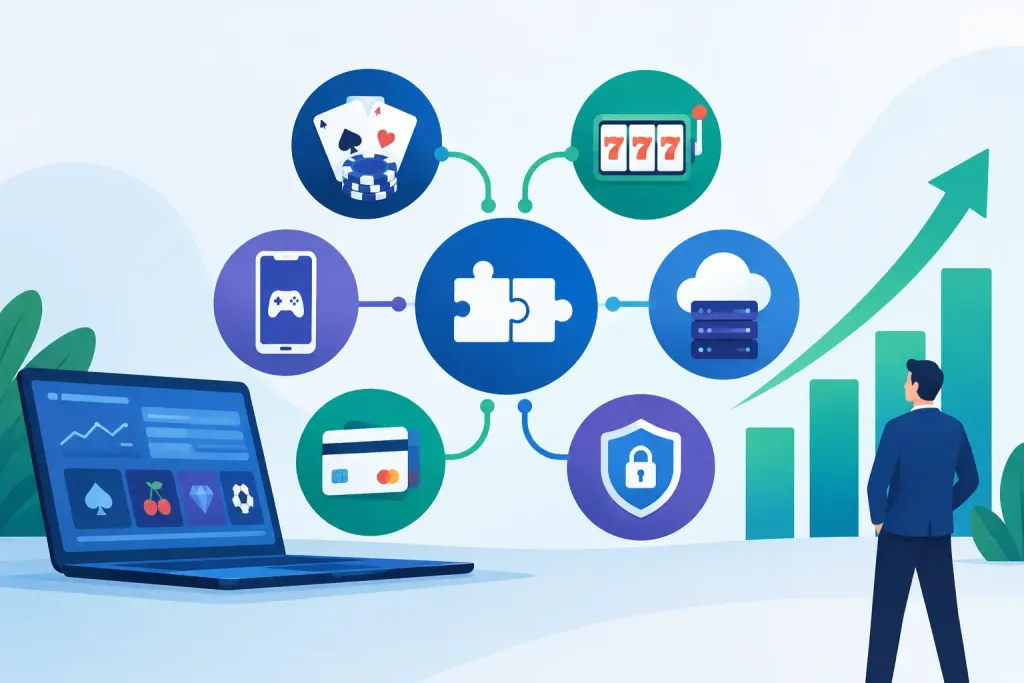
For serious operators, enterprise software is not simply a player-facing website with games attached. It is the operating layer behind the brand: the platform that connects content, wallets, payments, player accounts, promotions, reporting, risk controls, and back-office workflows. The quality of that layer determines how quickly a business can enter a market and how confidently it can scale once player volume increases.
What iGaming Enterprise Software Must Deliver
Enterprise-grade iGaming infrastructure has to support commercial speed without sacrificing operational discipline. A platform may look complete during a demo, yet prove costly if every new provider, currency, market, or campaign requires a separate technical project. The right system gives product, operations, and technical teams the ability to move quickly within defined controls.
One Operating Layer Instead of a Vendor Puzzle
Most operator complexity begins with integration sprawl. One provider supplies casino content, another manages sports betting, another handles payments, and several more provide identity checks, messaging, analytics, or bonus functionality. Each connection has its own data model, update cycle, support process, and failure point.
A unified platform reduces that exposure. A single API can provide access to aggregated gaming content while maintaining consistent player, wallet, and transaction logic across products. This matters when an operator wants to add providers, launch a localized catalog, or replace underperforming content without rebuilding its core experience.
Vendor consolidation is not about using fewer tools at any cost. Specialist services may still be necessary in certain jurisdictions or for particular risk requirements. The goal is to ensure the platform remains the system of control, rather than becoming a thin interface held together by custom connections.
Architecture Built for Peak Demand
Gaming traffic is uneven. Major sports events, campaign launches, tournament deadlines, and jackpot activity can produce sharp spikes in sessions and transactions. Infrastructure that performs adequately under average load can become a commercial liability during the moments that matter most.
Enterprise architecture should be engineered around availability, transaction integrity, and recoverability. That includes scalable services, monitored performance, secure data handling, controlled deployment processes, and clear incident response procedures. Operators also need reliable wallet behavior. A delayed or inconsistent balance update damages player confidence immediately, particularly when real money is involved.
High performance is not only a technical metric. It affects acquisition efficiency, player retention, support volume, and the ability to run promotions with confidence. If a campaign drives demand that the platform cannot absorb, marketing spend becomes a direct source of operational risk.
The Core Capabilities That Drive Operational Control
A capable platform connects technical functions to daily business decisions. Operators need visibility into what is happening across player journeys, financial activity, content performance, and support operations without exporting critical data from multiple disconnected dashboards.
Content Aggregation and Product Flexibility
Content breadth attracts attention, but content control builds a sustainable operation. An effective aggregation layer should make it practical to organize game libraries by market, player segment, device type, and commercial priority. Operators need to activate, deactivate, and promote content without waiting for extensive development cycles.
The same principle applies to sportsbook capability. Markets, odds feeds, settlement rules, risk parameters, and front-end presentation must operate within a stable framework. Casino and sportsbook products can share player identity and wallet logic, but their operational needs are not identical. A platform should support both without forcing teams into rigid workflows.
Certification requirements also influence content strategy. A game or provider that is available internationally may not be suitable for every regulated market. Enterprise software should help operators manage approved content sets and launch configurations with jurisdictional requirements in mind.
Payments That Match How Players Transact
Payment localization is often the difference between interest and conversion. Players expect familiar deposit methods, fast withdrawals, transparent transaction status, and support for their preferred currency. For international operations, that may include fiat currencies, crypto-ready payment modules, and market-specific payment options.
The technical challenge is larger than connecting payment methods. Operators need controlled routing, transaction monitoring, reconciliation support, wallet accuracy, and clear handling for failures, reversals, and pending states. Payment data also needs to feed reporting and customer support workflows in real time.
There is no universal payment stack. A crypto-forward entertainment brand and a regulated operator entering a tightly controlled market will make different choices. The platform must provide flexibility while preserving security, auditability, and a consistent player experience.
Back-Office Management That Teams Can Use
Back-office systems determine how effectively an operator can act on information. User management, permission controls, bonus configuration, transaction reviews, content controls, and support tools should be accessible through structured workflows, not dependent on engineering intervention.
Role-based access is especially important as organizations grow. Marketing teams may need campaign tools, support agents may need player histories, and finance teams may need reconciliation visibility. None of those roles should receive unnecessary access to sensitive data or platform controls.
A well-designed back office also creates accountability. Teams can understand who changed a configuration, when it changed, and what business impact followed. That operational traceability supports better decision-making and simplifies internal reviews.
Security, Data Integrity, and Market Readiness
Security cannot be added after launch. Player data, payment information, account access, and transaction records require protection at every layer of the platform. Operators should evaluate how a provider handles authentication, data access, monitoring, infrastructure controls, and business continuity.
Regulatory readiness adds another dimension. Requirements vary by jurisdiction, but operators consistently need reliable reporting, controlled access, auditable records, and the ability to adapt policies as markets evolve. Software certification and compliance capabilities should be assessed early, especially when market entry timelines are aggressive.
Build, Buy, or Combine Both?
Building proprietary infrastructure can make sense for large operators with mature engineering resources, a specialized product model, and the time to maintain critical systems over multiple years. It offers maximum control, but it also creates a permanent obligation to manage integrations, security, uptime, payment relationships, and regulatory change.
For many operators, a turnkey or white-label platform produces a stronger business case. It reduces initial development time and provides proven components for player management, content access, payments, and administration. The trade-off is that buyers must carefully assess configuration depth, API quality, ownership of operational data, and the provider’s capacity to support future requirements.
A hybrid approach is often the most practical. The operator deploys enterprise infrastructure for core functions, then builds differentiated front-end experiences, loyalty mechanics, analytics models, or regional features where proprietary investment creates measurable value. This approach keeps technical effort focused on competitive advantage rather than commodity platform maintenance.
How to Evaluate an Enterprise Platform Partner
Decision-makers should look beyond feature checklists. Two platforms can claim similar capabilities while producing very different outcomes during launch and scale. The questions below reveal whether a provider can support the operating model behind the product.
First, examine integration maturity. Ask how content, payment, and third-party services are connected, how changes are versioned, and what happens when a provider experiences an outage. Second, assess the back office through real scenarios: launching a promotion, investigating a disputed transaction, setting user permissions, or preparing market-specific reporting.
Third, test scalability claims with specifics. What performance thresholds have been achieved? How is capacity monitored? What service and support process applies when a priority incident occurs? Finally, clarify the commercial and technical boundaries of the partnership. Operators need to know what can be configured independently, what requires provider involvement, and how the platform will evolve as new markets and products are added.
Gameifylabs approaches this requirement as an infrastructure partnership, combining unified API access, turnkey platform capability, payment infrastructure, and back-office control for operators that need to launch without assembling an unstable vendor stack.
Launch Fast Without Creating Future Friction
Speed to market has value only when the launch foundation can carry the next stage of growth. A rushed deployment with weak payment handling, unclear operational ownership, or limited content controls will create expensive remediation work later. The better path is a focused implementation that prioritizes the markets, payment methods, content categories, and workflows most relevant to the initial commercial plan.
Start with a clear operating design. Define which teams own player support, payments, promotions, risk review, and content management. Establish the data and reports each team needs before launch. Then configure the platform around those decisions rather than treating operations as an afterthought.
The strongest iGaming businesses treat software as a growth system, not a one-time launch expense. When infrastructure gives teams control over content, payments, player journeys, and performance, the brand can respond to opportunity without rebuilding its technical foundation every time the market changes.


DiscussionHave a technical perspective or question?Open discussion