
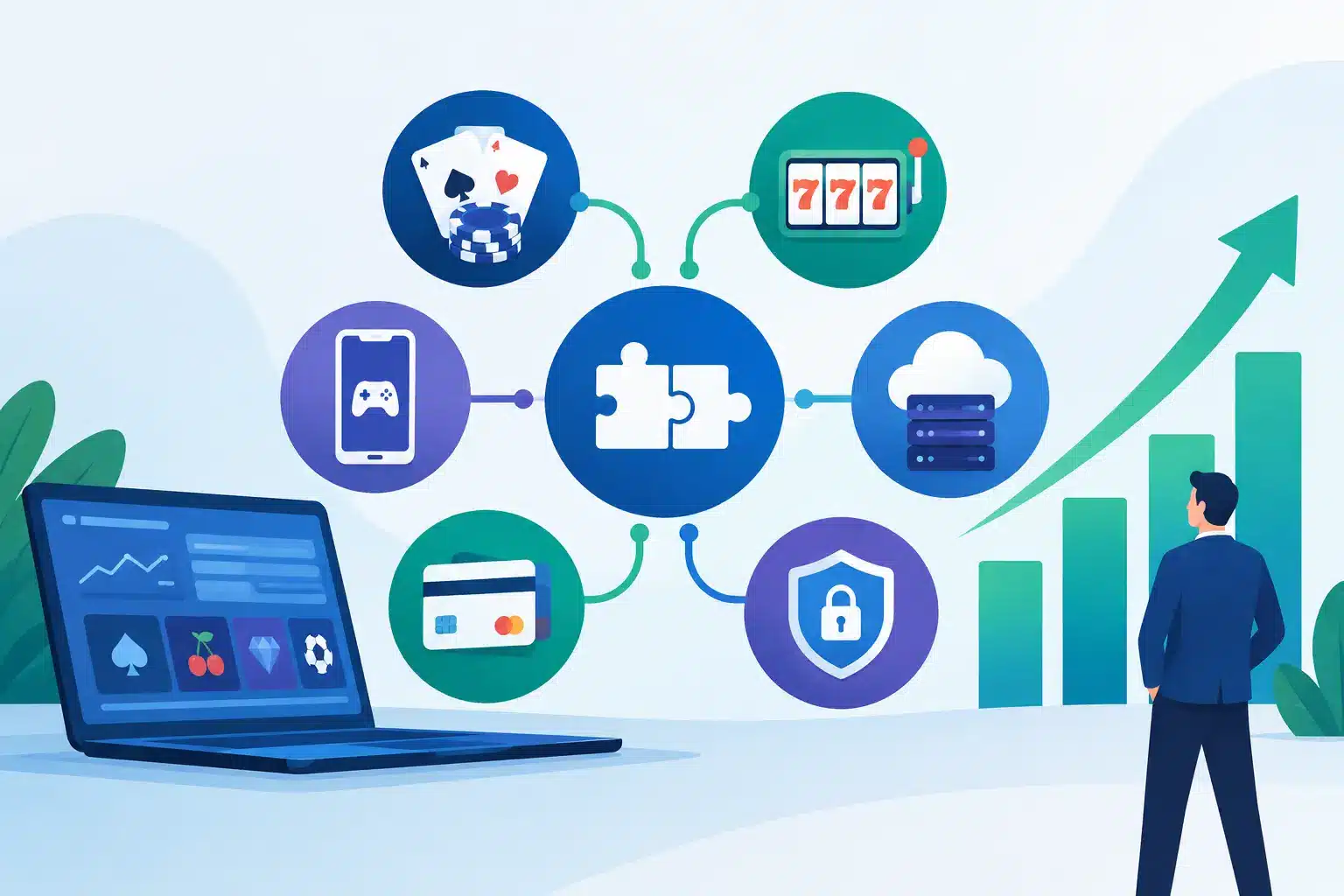
A new casino or sportsbook rarely fails because the brand lacks a strong concept. It loses momentum when game content, payments, player accounts, bonus logic, reporting, and compliance tools operate as disconnected systems. Effective iGaming systems integration turns those dependencies into one controlled operating environment – giving operators a faster route from launch plan to revenue-producing platform.
For operators entering a regulated market, expanding into new territories, or replacing an aging platform, integration is not an implementation detail. It determines how quickly the business can launch, how reliably it can process transactions, and how much control teams retain as the product portfolio grows.
What iGaming systems integration should deliver
At its core, iGaming systems integration connects the systems that run an online gaming business. This usually includes a player account management environment, casino and sportsbook content, payment service providers, KYC and AML tooling, CRM capabilities, bonus engines, reporting layers, and back-office controls.
The objective is not simply to make APIs communicate. The objective is to create a consistent operating model across the player journey and the operator workflow. A player should be able to register, verify an account, deposit in a preferred method or currency, access approved content, receive an eligible promotion, and withdraw funds without encountering conflicting data or unnecessary handoffs.
For the operator, the same architecture should provide a reliable view of player activity, wallet balances, risk exposure, content performance, campaign results, and operational exceptions. When each vendor maintains a separate version of the truth, support teams spend time reconciling records rather than resolving issues. Finance teams face delayed settlement processes. Product teams hesitate to release changes because a minor update can affect several external connections.
A well-designed integration layer reduces that operational drag. It also gives leadership a more realistic basis for decision-making, because the data used for growth, compliance, and commercial planning is aligned across the platform.
The systems that create the most integration risk
Not every connection has the same business impact. Some integrations are largely informational, while others directly affect player funds, regulatory obligations, or the availability of the gaming product. Those high-impact areas require clear ownership, tested failure behavior, and ongoing monitoring.
Content aggregation and game operations
Casino content is often sourced from multiple studios, each with its own launch requirements, game metadata, promotional mechanics, certification coverage, and release cadence. Connecting every provider independently can expand content choice, but it also multiplies technical and operational overhead.
An aggregation model centralizes that complexity through a single API or managed integration layer. It can accelerate access to a wider catalog while creating a more consistent process for game configuration, player session handling, reporting, and provider updates. The trade-off is that operators must assess the aggregator’s content depth, market availability, platform performance, and ability to support provider-specific features.
A broad catalog alone is not a growth strategy. The more useful question is whether the integrated content can be organized, promoted, localized, and measured through the operator’s back office. If game data cannot inform merchandising and retention activity, content scale becomes harder to convert into commercial value.
Payments, wallets, and settlement
Payment integration is where platform reliability becomes immediately visible to players. Deposit approval rates, withdrawal speed, fraud controls, currency support, and payment method coverage all influence trust and lifetime value.
A fragmented payment setup may require separate wallet rules, reconciliation processes, and reporting views for every provider. A unified payment layer can simplify orchestration by routing transactions through approved methods while maintaining common controls for transaction status, limits, fees, and player balances.
However, no single payment configuration is correct for every market. Local preferences, banking access, regulatory rules, and the risk profile of the operator all matter. Multi-currency and crypto-ready capabilities can support international expansion, but they must sit within appropriate compliance, treasury, and risk-management processes. Speed is valuable only when the transaction flow remains secure and auditable.
Compliance and identity services
KYC, AML screening, geolocation, responsible gaming controls, and regulatory reporting should not be treated as add-ons introduced after launch. They need to be embedded in the player lifecycle and connected to the systems that manage accounts, wallets, bonuses, and activity records.
For example, a verification status must be available where deposit rules and withdrawal requests are evaluated. Self-exclusion or limit-setting actions must apply consistently across relevant products. Suspicious activity monitoring requires accurate transaction and gameplay data, not incomplete exports assembled after the fact.
The exact integration scope depends on licensing jurisdictions and operating model. A platform serving one market may prioritize a specific identity provider and reporting format, while a multi-market operator needs configurable controls that can adapt without rebuilding the entire stack. Architecture should support that variation from the start.
Back-office management and data flow
The back office is the operational control center of an iGaming business. It should allow authorized teams to manage player accounts, configure promotions, review transactions, monitor game activity, handle support cases, and generate reporting without relying on multiple vendor portals.
This is also where poor integration becomes expensive. If customer support cannot see the reason for a failed withdrawal, or finance cannot reconcile a wallet event with a payment record, service quality declines quickly. Shared data definitions, role-based access, detailed audit logs, and near-real-time event visibility are essential.
A centralized back office does not mean every team needs unrestricted access. Enterprise-grade control requires permission models that match operational responsibilities. Marketing may need campaign and segmentation tools; risk teams need alert workflows; finance needs settlement data; technical teams need logs and status visibility. Each group should have the information necessary to act without exposing data beyond its role.
Build for change, not only for launch
The fastest initial integration is not always the strongest long-term choice. Operators often begin with a limited product set and add providers, markets, payment methods, and retention tools as acquisition grows. If the original architecture cannot absorb those changes, every expansion project becomes a costly custom development effort.
A scalable approach uses standardized APIs, documented data contracts, controlled release processes, and clear separation between core platform functions and external services. This makes it easier to replace a payment provider, introduce a new content supplier, or configure market-specific rules without destabilizing the whole environment.
Availability also deserves more than a generic uptime claim. Operators should understand how the platform handles provider outages, delayed callbacks, duplicate transaction requests, and peak-event traffic. A payment service can be temporarily unavailable. A game provider can return an unexpected status. A sportsbook can experience extreme demand during a major event. The integration design should define what happens next, how the player is informed, and how operations teams recover or reconcile the affected activity.
That level of preparation protects revenue, but it also protects brand credibility. Players may never see the technical architecture, yet they experience its quality in every login, wager, deposit, and withdrawal.
A practical framework for evaluating integration partners
Before selecting technology partners, operators should map the complete player and operations journey rather than evaluating each service in isolation. The most useful review asks where data originates, where it is transformed, who owns it, and what occurs if a dependency fails.
A serious integration partner should be able to demonstrate four capabilities:
- A unified API strategy that reduces the number of direct vendor connections while preserving access to required content and services.
- Configurable back-office controls for player management, bonuses, reporting, permissions, and operational oversight.
- Secure transaction architecture with clear wallet logic, payment monitoring, auditability, and support for relevant currencies and methods.
- Scalable infrastructure backed by performance testing, incident processes, technical support, and a realistic approach to market-specific compliance.
Commercial terms matter as well. A lower integration cost can become expensive if it requires constant custom work, limits access to needed providers, or prevents the operator from owning critical operational data. Conversely, an all-in-one platform may reduce launch complexity but should still offer enough configurability to support differentiation as the brand matures.
The right decision depends on business stage. A startup may prioritize a turnkey environment that shortens time to market. An established operator may prioritize migration control, high-volume performance, and the ability to consolidate existing vendor relationships. Both need clarity on implementation ownership, testing responsibilities, support escalation, and future roadmap alignment.
Integration as an operating advantage
For serious operators, platform infrastructure is not a background utility. It is the mechanism that connects commercial ambition to daily execution. When systems are integrated around a common player, wallet, data, and back-office model, teams can launch promotions faster, resolve issues with greater confidence, add content with less disruption, and enter new markets with more control.
Gameifylabs approaches this challenge through unified API connectivity, turnkey platform capabilities, aggregated gaming content, secure payment infrastructure, and back-office management designed for operators that need to build and scale without assembling a fragmented stack. The result should be more than a quicker launch. It should be an operating foundation capable of supporting the next market, the next product, and the next stage of growth.


DiscussionHave a technical perspective or question?Open discussion