
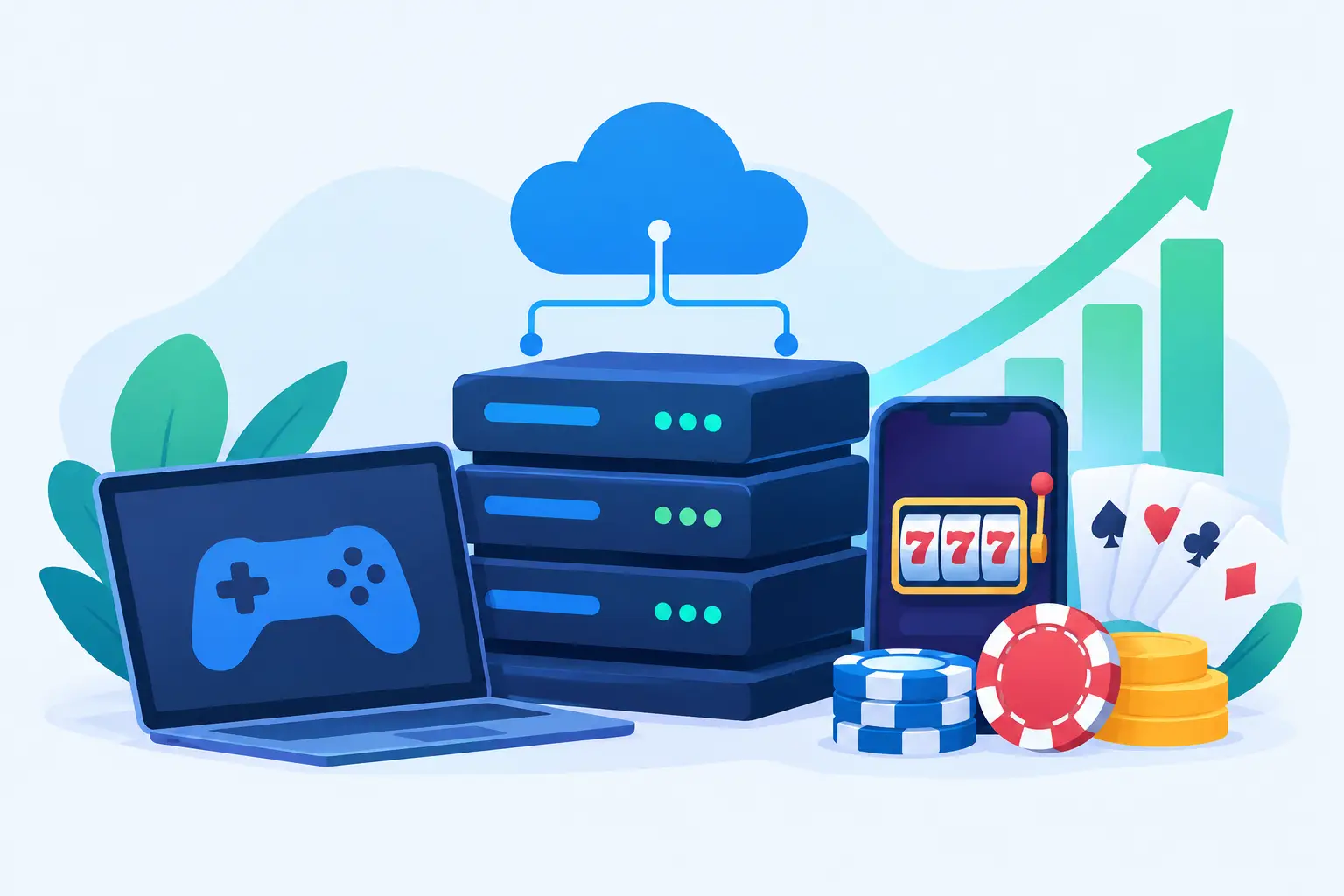
A polished casino lobby or sportsbook interface can win initial attention, but the backend determines whether an operator can retain players, settle bets accurately, process withdrawals, and expand into new markets without operational disruption. Gaming backend development is where commercial ambition becomes an operating platform: the services, rules, data flows, and controls that keep an iGaming business running under real demand.
For operators, the question is not whether a backend is necessary. It is whether the backend can support the next stage of growth without creating a chain of manual workarounds, disconnected vendors, and compliance exposure.
What Gaming Backend Development Actually Covers
Gaming backend development is the engineering of the systems behind a digital casino, sportsbook, or gaming platform. It connects the player-facing experience with game providers, payment services, customer management, wallets, bonus logic, reporting, risk controls, and operational tools.
A serious backend does more than receive requests and return data. It maintains a reliable source of truth for balances, transactions, game rounds, wagers, rewards, and account status. Each action must be recorded accurately, processed quickly, and made available to the right teams through back-office controls.
That scope makes backend architecture a business decision, not only a technical one. A platform that launches quickly but cannot add payment methods, reconcile provider data, or enforce market-specific rules will eventually slow commercial expansion. Conversely, a well-designed backend creates room to introduce new content, automate operations, and enter additional jurisdictions with less rework.
The Core Systems Behind a Scalable Platform
The exact architecture depends on the product mix, target markets, and regulatory model. A casino-first operation has different priorities from a sportsbook with high-frequency odds updates. Still, most scalable platforms depend on several connected capabilities.
Player accounts, wallets, and transaction integrity
The player account is the operational center of the platform. It must hold identity and verification status, preferences, limits, promotional eligibility, account restrictions, and activity history. It also needs to communicate clearly with the wallet layer, where deposits, withdrawals, wagers, wins, adjustments, and bonus funds are managed.
Wallet design deserves particular attention. A balance is not simply a number displayed on screen. It is the result of a traceable transaction ledger. Every debit and credit should be idempotent, meaning a repeated provider request cannot charge or pay the player twice. This is critical when network interruptions, retries, or delayed callbacks occur.
For multi-brand or multi-market businesses, the wallet also needs clear rules around currencies, exchange rates, restricted funds, and settlement. Crypto-ready operations add another layer of consideration, including confirmation handling, asset volatility, and controls for transaction monitoring.
Content aggregation and game session management
Operators want broad content access, but each provider brings its own API behavior, game launch process, transaction messages, and reporting format. Without an aggregation layer, the platform team may be forced to maintain separate integrations and operating procedures for every supplier.
A unified API normalizes this complexity. It gives the operator a consistent method for creating sessions, receiving game events, managing catalogs, and reconciling financial outcomes. The commercial advantage is significant: new studios or game verticals can be added without rebuilding the core player journey each time.
The trade-off is that abstraction must not hide critical provider-specific behavior. The backend should standardize common actions while preserving the reporting detail and configuration controls needed for game-level operations. A generic integration that cannot expose provider settings, jackpot data, or jurisdictional availability creates avoidable friction later.
Sportsbook event, odds, and settlement services
Sportsbook backend requirements are especially demanding because the state of the product changes continuously. Odds updates, market suspensions, bet acceptance rules, result feeds, cash-out calculations, and settlement events all need low-latency handling.
The backend must validate a wager against the latest acceptable price and market status before confirmation. It must also create an immutable record of the accepted bet, including the odds, stake, selection, time, and applicable rules. When settlement arrives, the platform must calculate outcomes correctly and make adjustments that can be audited.
Speed matters, but consistency matters more. During high-volume events, accepting bets on stale prices or processing duplicate settlements can quickly become a financial and reputational problem. Operators need infrastructure built for peak demand, not average traffic.
Payments, risk, and compliance controls
Payment localization is a growth lever, particularly for brands operating across regions. Players expect familiar deposit options and fast withdrawals, while operators need payment routing, fraud controls, reconciliation, and visibility into exceptions.
The backend coordinates these requirements. It should support multiple payment providers without making the cashier experience inconsistent, and it should separate payment status from the player wallet until funds are confirmed. This distinction prevents balance errors when a payment is pending, reversed, or disputed.
Compliance functions also belong close to the core platform. Depending on the market, this may include identity verification, age checks, geolocation, self-exclusion, deposit limits, source-of-funds workflows, and suspicious activity monitoring. These controls cannot be treated as isolated add-ons. They influence whether an account can play, deposit, withdraw, receive a bonus, or access a specific product.
Back-office management and operational data
A strong backend gives operations teams control without requiring engineering intervention for routine tasks. Back-office tools should make it possible to review player accounts, investigate transactions, configure bonuses, manage content availability, set limits, and respond to support cases through permission-based access.
Equally important is data quality. Finance, risk, CRM, customer support, and leadership teams may view the same player activity through different lenses, but their reporting must reconcile. Event-driven data pipelines can help distribute real-time activity to analytics and marketing systems, while the transactional ledger remains the financial authority.
Architecture Decisions That Affect Growth
Not every operator needs a fully custom platform from day one. The right approach depends on timeline, differentiation, technical capacity, licensing strategy, and the number of markets planned.
A turnkey platform is often the practical route when speed to market and operating stability are the immediate priorities. It provides proven modules for player management, content, payments, and back-office workflows, reducing the integration burden. The constraint is that customization should be evaluated carefully. If the brand requires highly differentiated trading logic, loyalty mechanics, or data workflows, the platform must offer sufficient API access and configuration depth.
A custom build can give greater control over product behavior and ownership of the technical roadmap. However, it also creates responsibility for provider integration, security, infrastructure, incident response, maintenance, and regulatory change. Building a wallet or reporting service is not a one-time project. It is an ongoing operational commitment.
For many businesses, the strongest model is modular. Use certified, production-ready infrastructure for foundational services, then develop the product layers that genuinely differentiate the brand. This concentrates internal investment where it generates competitive value rather than recreating commodity platform functions.
Security and Reliability Are Product Features
In iGaming, security failures are not abstract IT incidents. They can affect player funds, regulatory standing, partner confidence, and the ability to continue operating. Backend security should include encryption for sensitive data, strong authentication, granular access roles, audit logs, secure API controls, vulnerability management, and continuous monitoring.
Availability needs the same discipline. A platform can have excellent average performance and still fail commercially if it cannot withstand traffic spikes during major sporting events or promotional campaigns. Capacity planning, load testing, database resilience, queue management, and recovery procedures should be designed before peak traffic exposes the gaps.
Observability is central here. Teams need real-time visibility into failed deposits, latency increases, provider callback errors, unusual wagering patterns, and settlement backlogs. Alerts should be tied to meaningful service thresholds, not just infrastructure metrics. A high CPU reading is useful, but an increasing number of unconfirmed bets is a direct business signal.
How to Evaluate a Gaming Backend Partner
Decision-makers should look beyond feature lists. The most useful evaluation focuses on how the platform performs under operational pressure and how easily it can evolve.
Ask whether the provider can demonstrate a unified integration model for content and payments, clear wallet and transaction controls, configurable back-office management, and support for multi-currency operations. Confirm how the platform handles provider outages, duplicate transaction requests, player disputes, reporting reconciliation, and jurisdiction-specific restrictions.
It is also worth examining the delivery model. A capable partner should be able to define the launch scope, identify dependencies early, configure the platform around the brand’s operating model, and support growth after go-live. Infrastructure quality is only valuable when it is implemented with commercial discipline.
Gameifylabs approaches this challenge as a unified infrastructure opportunity: bringing content aggregation, turnkey platform capabilities, payment infrastructure, and operational control into a connected technology stack rather than leaving operators to manage fragmented systems.
The best time to strengthen backend foundations is before volume, regulation, and vendor complexity force the issue. Build around accurate transactions, clear operational control, and integrations that can grow with the business, then let the front end compete with the confidence that the platform underneath can deliver.


DiscussionHave a technical perspective or question?Open discussion