

Payment performance is not a back-office detail in iGaming. A rejected deposit can end a player session before it creates revenue, while an unreliable withdrawal process can damage trust long after the first transaction. A gaming payment orchestration platform gives operators the control layer needed to manage these moments across payment service providers, currencies, markets, and player segments.
For operators expanding across regulated and international markets, the challenge is rarely connecting one payment method. The real challenge is coordinating dozens of methods and providers without creating a fragmented payments stack that is difficult to monitor, expensive to maintain, and slow to adapt. Payment orchestration turns that complexity into an operational system.
What a Gaming Payment Orchestration Platform Does
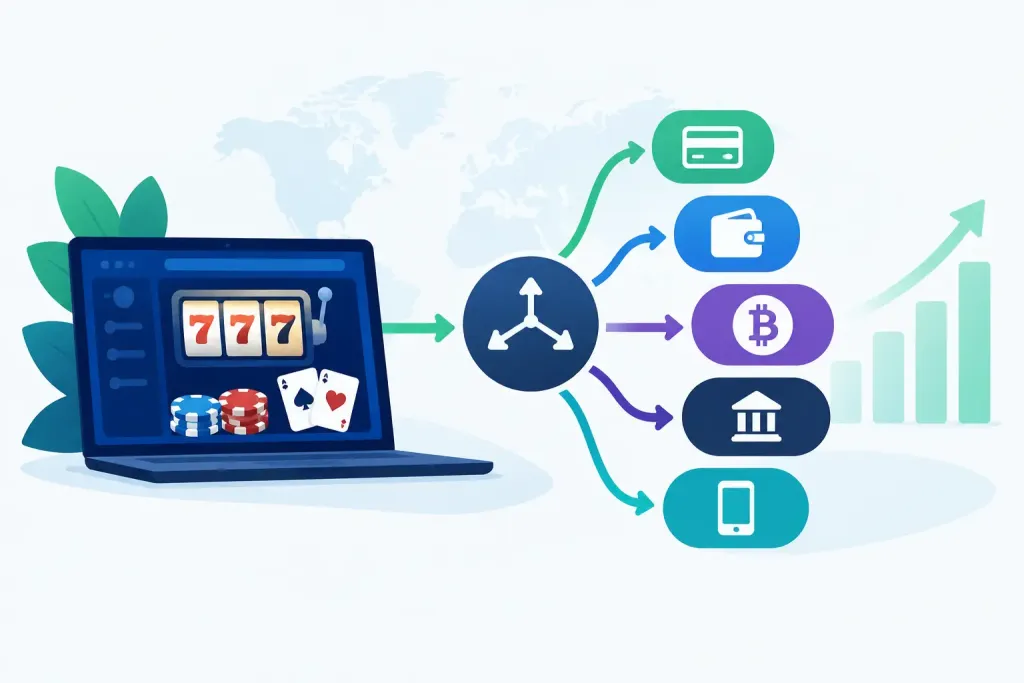
A payment orchestration platform sits between the gaming platform and payment providers. Instead of hard-coding separate integrations for every acquirer, e-wallet, bank transfer method, crypto rail, or payout partner, the operator connects through a unified layer. That layer routes transactions according to configurable business rules and returns transaction data to the casino or sportsbook platform.
In iGaming, orchestration must account for more than basic authorization. It needs to support deposits, withdrawals, reversals, refunds, chargeback workflows, player verification signals, responsible gaming controls, and jurisdiction-specific restrictions. The platform should also exchange reliable status updates with the operator’s wallet, bonus engine, CRM, fraud systems, and back-office management tools.
This architecture gives product and operations teams a practical advantage: payment logic can change without rebuilding the core gaming experience. If an acquirer experiences elevated declines, a preferred method becomes unavailable, or a new country requires local payment options, teams can adjust routing and provider priorities through the orchestration layer rather than launching a lengthy development project.
Why Payment Orchestration Matters for iGaming Growth
Gaming payments are shaped by local behavior. Card usage may dominate in one market, while instant bank transfers, mobile wallets, vouchers, or crypto payments may be expected in another. A single global provider can simplify procurement, but it may not deliver the local coverage or approval performance required to compete in every target geography.
A gaming payment orchestration platform allows operators to combine providers while presenting a consistent cashier experience to the player. The objective is not simply to add more payment methods. It is to make the right method available to the right player, in the right currency, with the right risk and compliance treatment.
Higher approval rates through intelligent routing
Authorization rates vary by payment provider, issuer, transaction value, geography, device, and player history. Sending every deposit through one route creates an unnecessary single point of failure. Intelligent routing can direct transactions based on predefined rules, such as market, card type, amount threshold, provider availability, or historical performance.
The strongest routing strategy is measured rather than assumed. Operators need visibility into approval rates by provider and method, including soft declines, hard declines, technical failures, and abandoned transactions. With that data, payment teams can identify whether a decline problem is caused by issuer behavior, a provider configuration, an unsupported payment flow, or a player experience issue.
Fallback routing can improve conversion when it is designed carefully. It should not repeatedly retry transactions in ways that increase fees, create duplicate authorization concerns, or frustrate the player. Risk rules, provider agreements, and local regulations all affect what is appropriate. More routing options are useful only when the rules behind them are disciplined.
Faster market entry without integration sprawl
Launching in a new jurisdiction often creates a predictable integration backlog. Local payment methods must be added, currencies configured, payout capabilities tested, reporting reconciled, and compliance requirements validated. When each connection is built directly into the gaming platform, every expansion adds technical debt.
Orchestration reduces that burden by standardizing the connection model. The platform can expose one payment API to the operator while managing multiple provider connections behind it. This does not remove the need for commercial due diligence, certification, or local compliance review. It does, however, prevent the payment layer from becoming the bottleneck that delays a market launch.
For startups, this can mean reaching operational readiness with a smaller engineering footprint. For established operators, it creates a more controlled path for replacing underperforming providers or adding regional alternatives without disrupting the wider platform.
Better payout control and player trust
Deposits often receive the most attention because they directly affect conversion, but withdrawals are where an operator proves reliability. Slow payouts, unclear status updates, and manual exception handling create avoidable support volume and can weaken player retention.
A well-designed orchestration layer coordinates payout routes, provider availability, wallet balance checks, transaction limits, and verification requirements. It also maintains a clear audit trail from withdrawal request to completion or rejection. Operations teams should be able to see why a payout is pending, which compliance check is incomplete, and whether the delay originates with the operator, the payment provider, or the receiving institution.
Automation should be applied with control. Low-risk payouts may qualify for faster processing, while larger or unusual transactions may require additional review. The right balance depends on the operator’s risk appetite, licensing conditions, player base, and fraud exposure.
Core Capabilities to Evaluate
Not every orchestration product is built for the operational demands of online casino and sportsbook businesses. A generic payments layer may process transactions effectively but lack the gaming-specific controls required for wallet-based platforms, regulated markets, and high-frequency deposit behavior.
When evaluating a solution, decision-makers should look beyond the number of available payment methods. Four capabilities matter most:
- Unified API and provider abstraction: The integration should normalize provider-specific fields, statuses, and error codes while retaining enough detail for troubleshooting and reconciliation.
- Configurable transaction routing: Operations teams need rule-based routing by country, currency, payment method, transaction value, player status, and provider performance.
- Deposit and withdrawal lifecycle management: The system should support asynchronous updates, reversals, refunds, payout approvals, and clear transaction-state handling.
- Actionable payment intelligence: Real-time dashboards and exportable reporting should reveal approval rates, failure reasons, provider uptime, costs, payout timing, and reconciliation exceptions.
Security and compliance are equally central. Payment data must be protected through appropriate tokenization, encryption, access controls, monitoring, and audit logging. Depending on the payment flows and jurisdictions involved, the solution may also need to support PCI DSS responsibilities, KYC and AML workflows, sanctions screening integrations, and data retention requirements.
Avoiding Common Implementation Failures
The most common mistake is treating orchestration as a provider directory. Adding multiple processors without a clear routing model can create inconsistent player experiences, duplicate transactions, difficult reconciliation, and higher operating costs. Every connection needs a defined purpose: primary processing, local coverage, backup capacity, payout specialization, or a specific payment method.
Another failure is separating payments from the player wallet architecture. In iGaming, transaction states must remain synchronized with player balances. A deposit marked successful by a provider but not credited in the gaming wallet becomes an immediate support and trust problem. The payment layer, wallet ledger, and back-office processes need tested handling for delayed callbacks, retries, duplicate notifications, and partial failures.
Operators should also avoid using approval rate as the only success metric. An apparently high approval rate may hide rising payment costs, poor payout performance, increasing fraud exposure, or a weak conversion rate at the cashier. A complete view combines authorization performance with payment method adoption, deposit completion, withdrawal time, chargebacks, provider costs, and player support contacts.
Building a Payment Stack for Scale
The right deployment model depends on the operator’s stage and market strategy. A single-market casino with a narrow payment mix may prioritize fast deployment and a proven local provider network. A multi-brand operator entering several jurisdictions will need more sophisticated routing, centralized reporting, and stronger separation between brands, entities, and regional payment rules.
The technical foundation should be built for change. Provider performance changes. Regulations evolve. Player preferences shift. A payment stack that requires core-platform releases for every new method or routing adjustment will eventually slow commercial execution.
Gameifylabs approaches payment infrastructure as part of the wider iGaming operating environment, connecting payment gateway capabilities with unified APIs, multi-currency support, back-office control, and scalable platform architecture. That alignment matters because payments perform best when they are designed alongside the wallet, player journey, reporting model, and market-entry plan.
The practical goal is simple: make it easy for legitimate players to fund and withdraw from their accounts, while giving the operator precise control over risk, costs, compliance, and provider performance. Build that control layer early, and payment operations can support expansion rather than forcing the business to work around its limitations.

DiscussionHave a technical perspective or question?Open discussion