
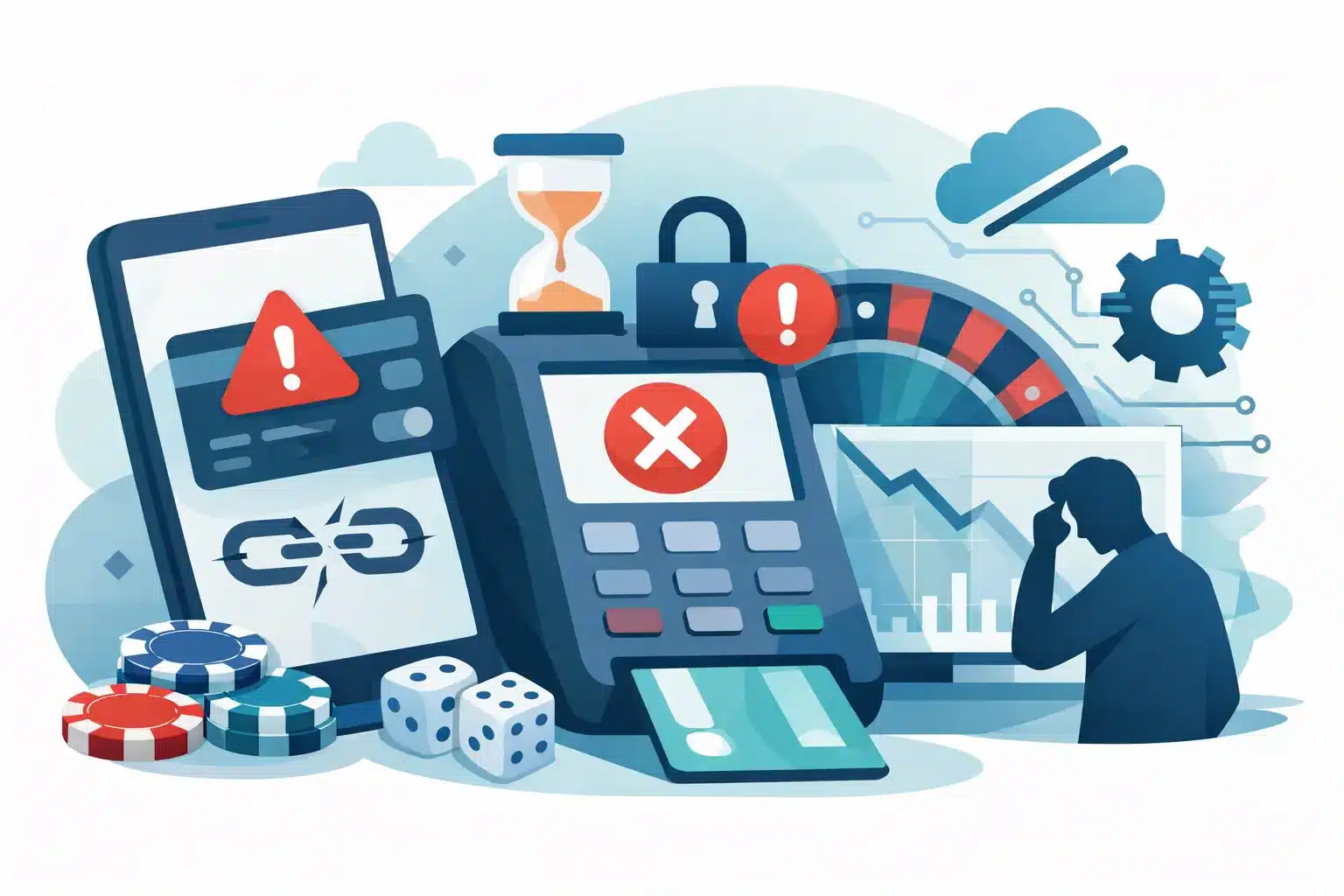
A player has chosen a payment method, passed account verification, and is ready to fund their balance. The deposit still fails. For operators asking why do casino payments fail, the answer is rarely a single gateway error. It is usually the visible result of decisions made across the issuer, acquirer, payment processor, fraud stack, regulatory controls, and the casino platform itself.
That complexity has direct commercial consequences. A failed deposit can end a first session, reduce campaign ROI, increase support volume, and push a high-value player toward a competitor. Payment performance is therefore not a back-office metric alone. It is a core acquisition, retention, and market-entry capability.
Why Do Casino Payments Fail Across the Payment Stack?
Online gaming is a high-scrutiny merchant category. Even when an operator is licensed and a player is legitimate, a transaction can be declined because one participant in the payment chain applies a rule that another participant cannot see or override.
A card deposit, for example, moves through the casino frontend, payment gateway, fraud screening engine, acquirer, card network, and issuing bank. Each system receives a different version of the transaction context. A bank may see a gaming merchant category code, an unfamiliar cross-border acquirer, an amount outside a player’s normal pattern, or a jurisdiction it does not support. The operator may only receive a generic decline response.
This is why a single-provider payment setup creates risk. One acquiring route, one fraud model, or one local payment option can become a commercial bottleneck when approval behavior changes.
Issuer Restrictions and Merchant Category Rules
Issuing banks remain one of the most common causes of payment failure. Some banks decline gambling-related transactions as a standing policy. Others allow them only in specific licensed jurisdictions, for specific account types, or below internally defined risk thresholds.
The merchant category code matters, but it is not the only signal. Issuers assess transaction velocity, historical chargeback exposure, device reputation, IP location, and whether the cardholder has previously completed gaming payments. A player who successfully deposited last month can still be declined today after an issuer updates its risk policy.
For operators, the practical implication is clear: card acceptance cannot be treated as a fixed capability. It must be monitored by issuer, country, card scheme, currency, and transaction type.
Compliance, KYC, and AML Controls
Payment approval does not exist separately from compliance. If player identity data is incomplete, inconsistent, or unavailable to the relevant screening workflow, a deposit may be rejected before it reaches the payment processor. The same is true when a transaction triggers sanctions screening, source-of-funds review, velocity limits, or suspicious activity controls.
These checks are necessary for regulated operations, but poorly designed workflows can create unnecessary friction. Repeated document requests, delayed verification states, and unclear status messages can cause players to abandon a deposit even when no final compliance issue exists.
The objective is not to weaken controls. It is to orchestrate them intelligently. Risk-based verification, clear exception handling, and a unified record of player activity help operators apply the right level of review at the right point in the journey.
Fraud Screening That Is Too Aggressive or Too Weak
Fraud systems work through probabilities, not certainty. If rules are too strict, legitimate players are blocked and deposit conversion falls. If they are too permissive, the operator absorbs fraud losses, chargebacks, bonus abuse, and regulatory exposure.
Casino payments are especially sensitive because fraud signals often overlap with legitimate player behavior. A player traveling internationally, using a mobile wallet for the first time, or making several deposits around a major sports event may look unusual to a generic model.
Effective risk management combines device intelligence, behavioral signals, account age, payment history, geographic checks, and transaction velocity. It also requires feedback loops. Chargeback outcomes and manual review decisions should improve the rule set rather than remain isolated in separate systems.
Localization Gaps Create Avoidable Deposit Declines
A payment method that performs well in one market may have little relevance in another. US players may expect cards, ACH-based options, digital wallets, or state-specific banking flows. Players in other regulated markets may favor bank transfers, instant account-to-account payments, prepaid methods, or local wallets.
When the checkout presents unfamiliar options, unsupported currencies, or unnecessary conversion costs, players do not always receive a technical decline. They simply leave. From a revenue perspective, abandonment and hard declines both reduce deposit completion.
Currency handling is equally important. A mismatch between the player’s preferred currency, the processing currency, and the settlement currency can trigger issuer concern or create fees that discourage repeat deposits. This becomes more significant for operators serving multiple regulated markets from a shared platform.
Localization must extend beyond logos in a cashier interface. It includes payment method availability, language, limits, settlement logic, local regulatory requirements, and routing to acquiring partners with strong regional performance.
Technical Failures Often Start Before the Gateway
Not every failed casino payment is a bank decline. Integration defects and platform architecture can interrupt a transaction long before the issuer makes a decision.
Common causes include expired API credentials, incorrect request signatures, duplicate transaction IDs, timeout settings that are too short, unsupported payment parameters, and inconsistent status mapping between the gateway and the player wallet. A platform may mark a deposit as failed when the provider is still processing it, or worse, fail to credit an approved payment because the callback was missed.
These issues become more difficult to manage when operators assemble their stack from disconnected vendors. The payment gateway, player account management system, KYC provider, fraud engine, bonus service, and back-office tools may each maintain their own transaction state. Reconciliation then becomes manual, slow, and error-prone.
A unified architecture reduces those failure points by keeping payment events, player data, risk decisions, and wallet updates synchronized. It also gives operations teams one source of truth when investigating disputed deposits or delayed payouts.
The Importance of Webhooks, Retries, and Idempotency
Payment processing is asynchronous. A player may close a browser, a network may fail, or a processor may return a pending state while continuing to seek authorization. The platform needs to handle each scenario without charging the player twice or losing a valid transaction.
Idempotency controls prevent duplicate processing when the same request is retried. Reliable webhook handling ensures that final provider statuses reach the wallet service. Clear retry logic distinguishes between a temporary processor timeout and a confirmed issuer decline.
These details are technical, but they materially affect revenue and trust. Players remember a deposit that disappears, a balance that takes too long to update, or a card that appears to have been charged twice.
Building a Payment Operation That Recovers Revenue
The strongest operators do not measure payments only by total processed volume. They track the full deposit funnel: method selection, payment initiation, authorization, fraud decision, wallet credit, and repeat use. This reveals whether the largest loss occurs at issuer approval, checkout abandonment, KYC friction, or platform error.
A resilient payment operation should support multiple acquiring routes and relevant alternative payment methods, with routing logic that can respond to market, currency, issuer behavior, and transaction risk. More providers do not automatically mean better results. Uncontrolled provider expansion can create reconciliation complexity and inconsistent player experiences. The value comes from managed orchestration, normalized data, and measurable performance by route.
Operators should also separate soft declines from hard declines. A temporary insufficient-funds response may justify a later retry prompt or an alternative payment suggestion. A policy-based issuer block requires a different method, not repeated attempts that frustrate the player and may raise fraud signals.
Finally, payment teams need operational visibility. Real-time alerts for elevated decline rates, provider latency, callback failures, and unusual chargeback patterns allow teams to act before an incident affects an entire market.
For platform owners, payment reliability is built into infrastructure choices made long before launch. A unified API, controlled cashier logic, integrated back-office reporting, and multi-currency payment capabilities give operators the control to diagnose failure patterns and adapt without rebuilding the core product. This is the operating model Gameifylabs is designed to support: payment infrastructure that helps gaming brands protect conversion while maintaining the compliance and security standards their markets demand.
The next failed deposit should not be treated as an isolated support ticket. It should be treated as a data point that shows where the payment journey needs stronger routing, clearer controls, or better technical coordination.



DiscussionHave a technical perspective or question?Open discussion