

A content deal can look excellent on paper and still slow your launch by months. That usually happens when operators underestimate what sits behind the games themselves: integration logic, release management, compliance mapping, cashier behavior, reporting consistency, and the operational load of keeping dozens of providers live at once. An igaming content aggregation platform exists to solve that problem, but not every aggregator solves it at the same level.
For operators, platform owners, and new market entrants, the real question is not whether aggregation matters. It does. The question is whether the platform you choose reduces technical friction or simply hides it behind another layer of dependency. That distinction affects speed to market, vendor overhead, player experience, and margin control.
What an iGaming content aggregation platform actually does
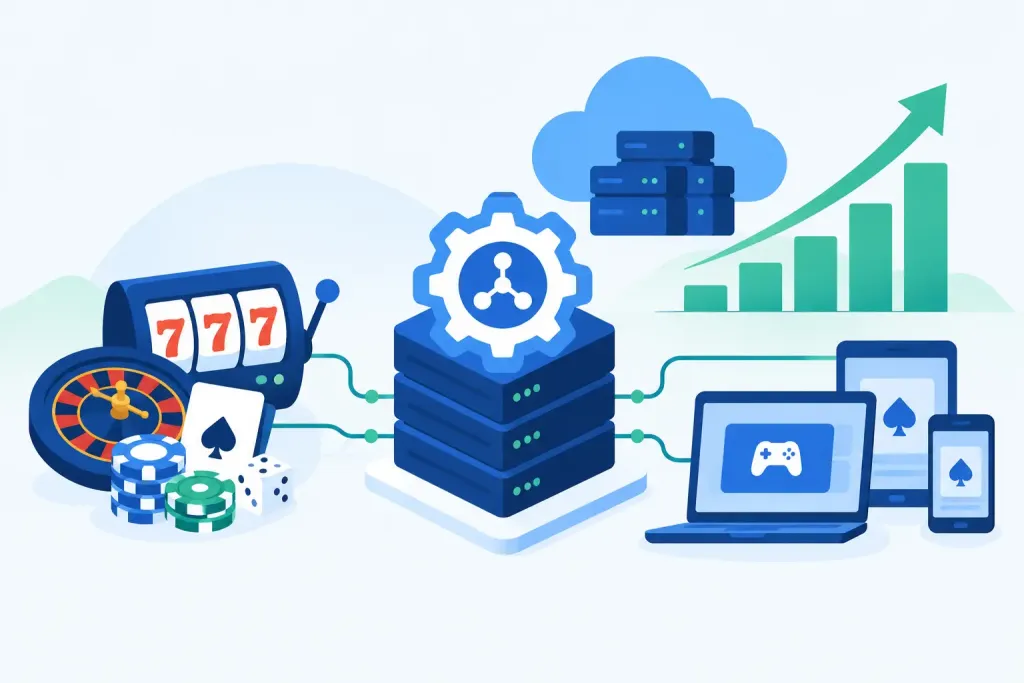
At a basic level, an iGaming content aggregation platform gives operators access to multiple game studios through a single technical connection. Instead of integrating each casino content provider one by one, the operator connects once and manages a larger catalog through one API and one commercial framework.
That sounds straightforward, but the stronger platforms do far more than route game feeds. They normalize game metadata, manage provider releases, support market-specific restrictions, centralize reporting, and simplify wallet behavior across content suppliers. In practice, the platform becomes a control layer between your front end, your player account system, and a fragmented supplier ecosystem.
This is why aggregation is not just a procurement shortcut. It is infrastructure. If that infrastructure is weak, operators end up carrying hidden complexity in QA, customer support, finance reconciliation, and compliance operations. If it is built correctly, the same platform can compress launch timelines and support expansion across markets without forcing the business to re-architect every few quarters.
Why operators move to an iGaming content aggregation platform
The most obvious benefit is faster deployment. A single integration can replace months of direct provider work, especially when each studio has its own technical standards, certification path, and release process. For a business trying to enter a market quickly, that alone can justify the model.
The second benefit is operational scale. Managing ten providers directly is difficult. Managing fifty becomes a full-time integration business inside your business. Aggregation shifts that burden to a specialist layer that is built to maintain provider connectivity, content updates, and catalog governance.
There is also a commercial advantage. Operators need breadth, but breadth without control can dilute performance. A well-structured aggregation platform makes it easier to test categories, rotate suppliers, analyze title performance, and shape a portfolio around retention and market demand rather than around whichever integrations were easiest to complete first.
That said, aggregation is not automatically the right answer in every case. Large enterprise operators with strong in-house engineering teams may still choose direct integrations for selected premium studios where they want custom promotional mechanics, exclusive release handling, or tighter commercial terms. For most businesses, though, the smarter model is mixed: aggregate for speed and scale, then add direct deals only where the upside is clear.
The features that matter most
A serious aggregation platform should be judged less by the raw number of games and more by the quality of control behind that catalog. A supplier list is easy to market. Stable delivery across jurisdictions is harder.
API reliability comes first. If the integration layer is inconsistent, every downstream function suffers. Game launch errors, session issues, reporting mismatches, and wallet disruptions damage both revenue and trust. Enterprise operators should expect mature API documentation, version control discipline, sandbox support, and clear incident handling.
Content management depth matters just as much. Operators need to organize titles by market, category, provider, device performance, RTP rules, and promotional eligibility. Without that level of control, a large catalog becomes noise. More content does not create more value if teams cannot merchandise it effectively.
Back-office visibility is another dividing line. The platform should give operations and product teams a unified view of content performance, player engagement patterns, and provider-level contribution. If reporting is fragmented or delayed, decision-making slows down. That becomes expensive when you are running acquisition campaigns and retention programs across multiple geographies.
Then there is wallet architecture. A fragmented wallet experience creates friction for players and complexity for finance teams. Operators should assess whether the aggregation layer supports a clean wallet flow, fast transaction synchronization, and dependable reconciliation across suppliers.
Finally, compliance support is not optional. The platform should help operators manage market access rules, certification requirements, and content restrictions without manual workarounds. In regulated environments, weak compliance tooling turns into launch delays and audit exposure very quickly.
Where aggregation platforms often fall short
The market is crowded with platforms that promise broad coverage but deliver shallow operational value. One common issue is the reseller model. In these setups, the aggregator sits between the operator and the original provider with limited technical authority and limited escalation power. That can work for basic access, but it becomes painful when issues arise around releases, game defects, or jurisdiction-specific approvals.
Another issue is poor standardization. Some platforms claim to offer a single API but still expose provider-specific inconsistencies that the operator must handle anyway. If bonus logic, free spin behavior, session flows, or reporting fields vary heavily between suppliers, the integration is only partially unified.
Latency and uptime also deserve close attention. Aggregation adds another infrastructure layer, which means it can either strengthen resilience or create another failure point. Operators should ask hard questions about hosting architecture, redundancy, monitoring, and historical performance. Broad content access means little if the trading day is interrupted by unstable middleware.
Commercial opacity is another risk. Aggregation can simplify contracts, but it can also make pricing less transparent. Margin compression often appears in hidden platform fees, provider pass-through costs, or unfavorable revenue-share structures attached to convenience. The right partner should be able to explain not just access, but how the model supports sustainable growth.
How to evaluate the right platform for your business
The right evaluation process starts with your operating model, not the aggregator’s sales deck. A startup brand entering one market with limited engineering resources has different needs than a multi-brand enterprise migrating from a legacy stack.
If speed to market is the priority, assess onboarding timelines, prebuilt integrations, and the quality of implementation support. If your focus is long-term margin and control, look more closely at reporting depth, promotional flexibility, and how easily the platform fits with your existing PAM, CRM, payments, and risk systems.
It also helps to think in terms of future complexity. Many operators buy for launch but suffer during expansion. A platform that works for one jurisdiction may become restrictive when you add localized payments, multiple currencies, crypto support, tax logic, or regional content limitations. The better choice is usually the one that can support your next two stages of growth, not just your first release.
Technical stakeholders should validate API maturity and infrastructure standards early. Product teams should test how content can be segmented, promoted, and optimized. Compliance and finance teams should examine reporting logic, auditability, and reconciliation workflows. Aggregation decisions are often treated as product decisions, but they affect nearly every operational unit.
For that reason, the strongest vendors position aggregation as part of a broader platform strategy. When content access, back-office management, user controls, and payment infrastructure are designed to work together, operators spend less time managing vendor overlap and more time improving acquisition, retention, and market coverage. That is where providers like Gameifylabs can create a clearer advantage: not by offering aggregation in isolation, but by embedding it inside a launch-ready infrastructure stack built for scale.
iGaming content aggregation platform strategy and growth
An iGaming content aggregation platform should not be viewed as a temporary shortcut before moving to a more serious architecture. In many cases, it is the architecture that makes serious growth possible. The key is selecting one that gives you leverage rather than dependency.
Leverage means you can expand content without multiplying integration work. It means your teams can launch faster in new markets, compare supplier performance with confidence, and maintain a consistent player experience across a broad portfolio. It also means the platform supports commercial decisions with clean data and stable delivery, instead of forcing your business to adapt to technical inconsistencies.
Dependency looks different. It appears when switching costs are high because reporting is weak, contracts are unclear, or core business logic sits inside proprietary workflows you do not control. It also appears when your roadmap is constrained by a vendor that can aggregate content but cannot support the wider platform demands around payments, security, and operational governance.
That is why the best buying question is not, “How many games do we get?” It is, “How much operational control do we keep as we scale?” The operators that ask that question early tend to build faster, migrate less, and protect margin more effectively.
Choose the platform that reduces complexity where it actually hurts – integration, compliance, uptime, reporting, and market expansion – and your content strategy will start acting like a growth engine instead of a maintenance burden.


DiscussionHave a technical perspective or question?Open discussion