

A new casino or sportsbook can look market-ready long before it is operationally ready. The difference often sits behind the interface: content feeds that do not reconcile, payment methods that fail in key territories, duplicated player records, or reporting that requires manual intervention. Gaming API integration is the infrastructure decision that determines whether an operator launches with control or inherits a costly collection of dependencies.
For operators and platform owners, the objective is not simply to connect more games. It is to establish a dependable operating layer across content, player accounts, wallets, payments, bonuses, compliance workflows, and back-office reporting. A well-designed integration reduces vendor friction at launch and provides the technical control needed to enter new markets without rebuilding the platform every time the business evolves.
What Gaming API Integration Must Deliver
An API integration is often described as a connection between systems. In iGaming, that definition is too limited. Each connection affects financial accuracy, player experience, regulatory obligations, commercial reporting, and the speed at which teams can introduce new products.
A production-grade integration must manage the full transaction lifecycle. When a player places a wager, the platform needs to validate the session, verify available funds, register the transaction, receive the provider response, settle the outcome, and preserve an auditable record. That workflow must remain consistent during high traffic periods, provider delays, retries, and network interruptions.
This is why the quality of the operating layer matters more than the number of endpoints listed in a technical document. Operators need predictable behavior across every provider, not a different exception model for every game studio, sportsbook feed, or payment processor.
One connection should reduce complexity
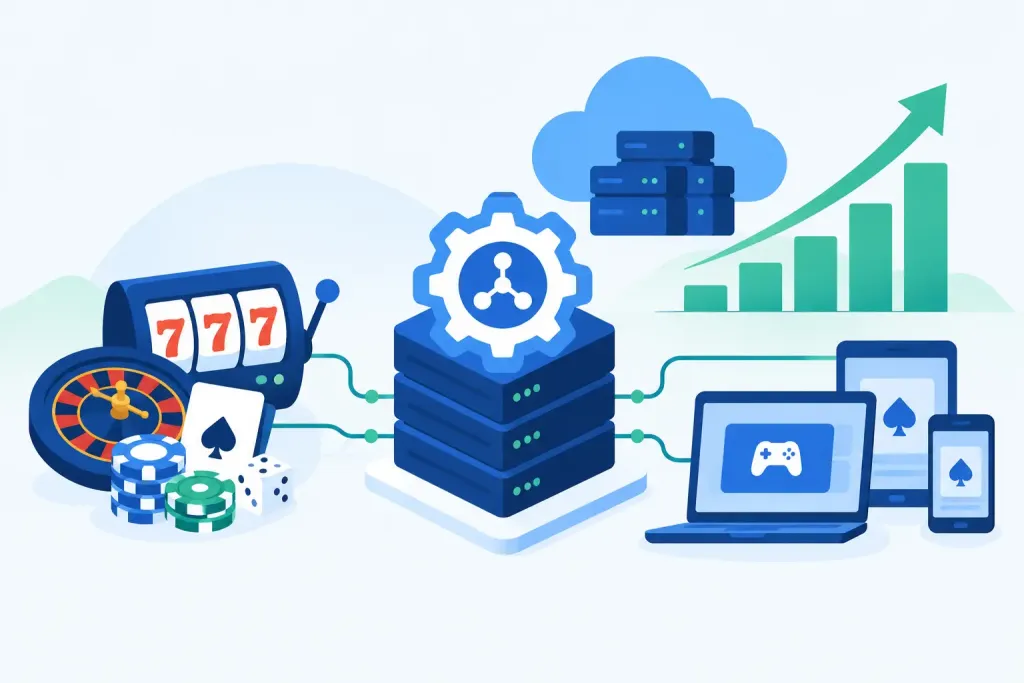
A unified gaming API gives an operator one standardized framework for accessing aggregated content. Instead of building and maintaining separate integrations for each supplier, product teams can manage games, categories, launch settings, player permissions, and reporting through a central platform.
The commercial benefit is direct. New content can be evaluated and activated with less development effort. Operations teams work from a more consistent set of controls. Finance and support teams spend less time investigating discrepancies caused by disconnected systems. For a growing brand, consolidation also creates a clearer view of which providers, markets, and player segments are contributing to revenue.
Standardization does not mean every provider behaves identically. Game mechanics, promotional capabilities, jackpot rules, and jurisdictional availability vary. The platform should normalize what can be normalized while preserving the provider-specific functions that create value. A quality integration layer handles this balance without forcing the operator to choose between simplicity and product depth.
Build the Integration Around the Wallet
The wallet is the financial center of an iGaming platform. It defines how deposits, withdrawals, wagers, wins, bonuses, reversals, and adjustments are recorded. If wallet logic is inconsistent across products, the operator faces disputes, reporting gaps, and avoidable exposure.
For most multi-product operations, a centralized wallet is the right architecture. The player maintains a single balance while the platform controls debit and credit requests across casino, live dealer, sportsbook, and other verticals. This approach gives the operator stronger financial oversight and a more coherent experience for the player.
There are trade-offs. A centralized wallet requires the platform to carry greater responsibility for transaction integrity, idempotency, retry behavior, and reconciliation. It also requires providers to follow defined protocols for round completion, rollback requests, and delayed settlement. Those demands are justified when the goal is to operate a scalable brand rather than a collection of isolated products.
Every transaction flow should answer practical questions before launch. What happens if a provider times out after a wager request? How are duplicate callbacks identified? Can a withdrawal be blocked during an active risk review? How are bonus funds separated from cash balances? Can operations trace a disputed wager from the player record through the provider round and ledger entry? These are not edge cases. They are daily operating requirements.
Content Aggregation Is Only Valuable With Control
Broad game access is commercially attractive, but content volume alone does not create a competitive product. Operators need control over how content is presented, localized, restricted, and measured.
A capable aggregation layer should let authorized teams organize content by provider, game type, market, currency, language, device, and availability status. It should support configurable lobbies and featured placements without requiring a release cycle for every merchandising change. It should also provide accurate game metadata, so teams are not manually correcting titles, images, categories, and compliance notices across multiple systems.
Market readiness requires more than translation. A game may be available in one jurisdiction but restricted in another due to certification, game rules, bet limits, or promotional limitations. The integration must enforce those rules before the player reaches the game session. Relying on manual checks or front-end filtering creates unnecessary compliance risk.
Performance is equally commercial. A slow game launch, failed session handoff, or inconsistent mobile rendering affects retention immediately. Operators should test content delivery under realistic conditions, including peak traffic, lower-bandwidth mobile sessions, and provider maintenance scenarios. The platform must be able to isolate a provider issue without making the rest of the casino unavailable.
Payments Need Local Coverage and Central Governance
Payment integration is often treated as a separate project from gaming content. Operationally, it cannot be. The deposit journey, player verification flow, wallet logic, withdrawal rules, and risk controls all affect conversion and retention.
The right payment architecture supports the methods players expect in each target market while maintaining central rules for limits, approvals, fraud monitoring, and settlement reporting. This can include cards, bank transfers, e-wallets, alternative payment methods, and crypto-ready modules where permitted by the operating model and jurisdiction.
Adding more payment options can improve reach, but it also increases reconciliation requirements and operational exposure. Each method has different settlement timing, chargeback behavior, documentation requirements, and withdrawal constraints. Operators should prioritize payment methods based on target-market demand, licensing conditions, transaction cost, and risk profile rather than treating every available method as a launch requirement.
A unified back office is essential here. Finance and operations teams need to see the relationship between a deposit, a bonus grant, a wager pattern, a withdrawal request, and any risk action taken against the account. Fragmented dashboards slow decisions at exactly the point where speed and evidence matter.
Security and Compliance Cannot Be Added Later
Gaming platforms process sensitive personal data and continuous financial transactions. Security is therefore part of the integration design, not a final pre-launch checklist.
Access control should follow defined roles, with separate permissions for operations, payments, customer support, risk, content management, and technical administration. API credentials require controlled issuance, rotation, monitoring, and immediate revocation procedures. Data should be protected in transit and at rest, while logs must preserve the evidence needed for incident investigation and regulatory review.
Compliance requirements depend on licensing jurisdictions and product scope, but the platform must be prepared to support identity verification, age checks, responsible gaming controls, transaction monitoring, geographic restrictions, and reporting obligations. An operator entering regulated markets should confirm how these capabilities connect to the player account and wallet before selecting providers.
Availability also has a security and compliance dimension. If a component fails, the platform needs clear rules for degraded operation. It may be acceptable to temporarily disable a single content provider. It is not acceptable to lose wallet accuracy or create uncertainty around player balances. High availability architecture, monitoring, alerting, and disaster recovery planning protect the business when normal operating conditions change.
How to Evaluate an Integration Partner
The best integration partner is not necessarily the vendor with the longest provider list. It is the partner that can demonstrate control over the operating model your business needs.
Start with the technical fundamentals: documented APIs, stable sandbox environments, versioning policies, observability, transaction reconciliation, and defined support escalation. Then assess the commercial layer: content availability by market, certification support, payment coverage, back-office capabilities, deployment timelines, and ownership boundaries between the platform, operator, and third parties.
Ask to see how exceptions are handled, not only how the standard flow works. A credible partner can explain how it manages failed callbacks, duplicate transactions, provider outages, delayed settlements, player disputes, and reporting corrections. These answers reveal far more than a feature checklist.
Gameifylabs approaches gaming infrastructure as a unified operating foundation, combining content aggregation, payment modules, player management, and back-office control in one enterprise-focused environment. This model is designed for operators that need to move quickly without accepting the long-term cost of a fragmented vendor stack.
Plan for Change Before You Launch
A platform is never finished at go-live. New markets create new payment requirements. Content portfolios change. Regulations evolve. Player acquisition strategies introduce different bonus logic and risk thresholds. The integration choices made at the beginning determine how expensive those changes become.
Operators should establish ownership for API configuration, provider onboarding, incident response, release testing, and data reconciliation from day one. They should also treat reporting as a product capability, not an administrative afterthought. Clear, reliable data gives leadership the confidence to expand, adjust commercial terms, and act on operational issues before they become customer-facing problems.
The strongest gaming API integration does not merely accelerate an initial launch. It gives the operator a platform that can absorb growth, market complexity, and product change while keeping financial control and player trust intact.


DiscussionHave a technical perspective or question?Open discussion