

A gaming brand can have a strong commercial strategy, a recognizable identity, and an acquisition plan ready to deploy, yet still lose months to technical fragmentation. iGaming software solutions determine whether an operator can turn that strategy into a live, controlled, high-performance product. The difference is rarely just a front-end design or a game catalog. It is the infrastructure underneath: APIs, player account management, payments, reporting, risk controls, and the operational tools that keep a platform running after launch.
For operators entering a new market or replacing aging technology, the objective is not simply to add more features. It is to establish an architecture that can support market-specific requirements without creating a new integration problem every time the business expands.
What iGaming Software Solutions Must Deliver
A serious iGaming stack connects the components required to operate an online casino, sportsbook, or multi-vertical entertainment product from a central foundation. That foundation should allow commercial teams to configure offers, operations teams to monitor activity, and technical teams to manage integrations without rebuilding the platform around each new provider.
At its core, the platform needs a reliable player account management environment. This is where registration, authentication, wallet activity, account status, bonuses, limits, and player lifecycle data are handled. If player data is scattered across separate systems, reconciliation becomes slower, support teams lose visibility, and compliance decisions become harder to audit.
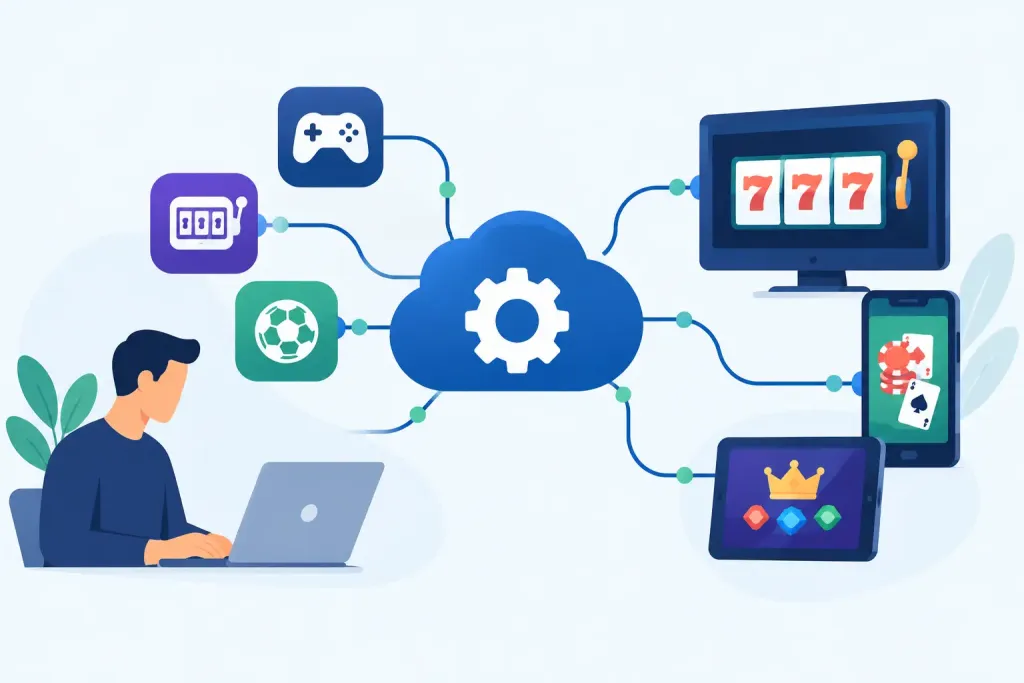
Content aggregation is equally critical. Operators need access to diverse casino content, live dealer products, sportsbook feeds, and other digital entertainment verticals, but every direct integration introduces maintenance obligations. A unified API reduces that burden by standardizing how games, odds, sessions, balances, and reporting data move between providers and the operator platform. The commercial advantage is speed, but the operational advantage is control.
Payments require the same level of attention. Deposit and withdrawal performance directly affects conversion, retention, and player trust. A payment layer should support multiple currencies, local payment methods, fraud monitoring, reconciliation, and crypto-ready capabilities where the operating model and jurisdiction allow it. There is no universal payment configuration: a solution built for one region may fail to meet player expectations in another. The infrastructure must be flexible enough to localize without becoming difficult to manage.
Fragmented Vendors Create Operational Drag
Many operators begin with a collection of point solutions. One provider supplies games, another manages payments, a separate vendor handles the sportsbook, and an internal team attempts to connect reporting and user management across the stack. This can work at an early stage, especially when a business has a narrow product scope. It becomes less effective as markets, transaction volumes, and content requirements grow.
Every vendor relationship creates another technical dependency, support path, release schedule, and potential failure point. When a player sees an incorrect balance or a transaction remains unresolved, the operator needs to identify whether the issue sits with the wallet, the payment service, the game provider, or the integration layer. A fragmented stack can turn a straightforward incident into a multi-party investigation.
Vendor consolidation is not about limiting choice. It is about placing critical functions inside a coordinated environment with clear ownership. A well-designed turnkey platform can still support third-party content and specialized integrations. The key is that these connections are managed through a stable core rather than assembled as isolated systems.
Architecture Should Match the Growth Plan
The right deployment model depends on the operator’s stage, regulatory scope, and internal technical capacity. A startup preparing its first market entry may prioritize launch speed and proven workflows. An established operator may need to migrate from legacy infrastructure while preserving player data, brand logic, and existing supplier agreements. A platform owner may require custom development to serve multiple brands from one back-office environment.
Turnkey platforms reduce time to market
A turnkey model is typically the strongest option when speed and execution certainty matter most. The operator receives a configured platform with essential services already connected: gaming content, wallet logic, payment modules, user management, reporting, and administrative controls. This avoids the cost and delay of building foundational systems before the commercial product can be tested.
The trade-off is that operators should validate how much configuration is available at the product, promotional, and brand levels. A turnkey platform should not force every business into the same player experience. It should provide tested infrastructure while allowing the operator to control branding, market setup, content presentation, bonus rules, and operational workflows.
Custom development protects strategic differentiation
Custom software development becomes valuable when the business model depends on capabilities that standard platform modules cannot deliver. This may include proprietary player journeys, specialized loyalty mechanics, unusual wallet behavior, partner portals, or enterprise reporting requirements. Custom work should extend a dependable core, not replace it without a clear commercial reason.
Building everything internally can appear attractive because it promises full ownership. In practice, it also creates permanent responsibility for security updates, certification requirements, provider changes, 24/7 incident response, and ongoing platform maintenance. The relevant question is not whether a team can build a feature. It is whether building and operating that feature creates a durable advantage for the business.
Security and Compliance Belong in the Core
Security cannot be treated as a post-launch add-on in iGaming. Platforms handle personal information, financial transactions, gameplay events, and data that may be subject to jurisdiction-specific controls. The infrastructure must protect these systems while preserving traceability for operations, compliance teams, and commercial reporting.
A capable solution should support secure authentication, controlled access permissions, encrypted data handling, transaction logging, monitoring, and dependable backup practices. Back-office management is especially important because it gives authorized teams the ability to review player activity, manage account actions, investigate payment exceptions, and maintain a clear audit trail.
Certification and compliance readiness also affect market expansion. Requirements vary by jurisdiction, and no provider can make regulatory obligations disappear. However, certified high-performance architecture and structured operational controls can reduce the technical work required to prepare for a new market. Operators should ask where compliance responsibilities sit, what data is available for reporting, and how quickly platform configuration can adapt to local rules.
Performance Is an Operating Requirement
A platform is judged by what happens during high-volume periods, not only during a controlled product demonstration. Traffic spikes around major sporting events, promotional campaigns, and payment peaks can expose weaknesses in session handling, wallet synchronization, or provider connectivity. Downtime does more than reduce revenue. It damages player confidence and increases pressure on support and operations teams.
High availability depends on architecture, monitoring, capacity planning, and response procedures. Operators need visibility into transaction status, game session behavior, API health, and user activity so they can identify issues before they become large-scale incidents. Cross-platform optimization also matters. Players move between mobile browsers, desktop devices, and different network conditions, so performance cannot be designed around a single ideal user environment.
The same principle applies to data. Real-time operational visibility helps teams make faster decisions about payments, player behavior, content performance, and risk events. Reporting that arrives too late may satisfy a recordkeeping requirement, but it does not help an operator actively manage the business.
Choosing a Technology Partner for Long-Term Control
The most effective provider relationship begins with operational questions, not feature checklists. Can the platform support the intended launch markets? How are new content providers added? Who owns incident coordination? What can business users configure without engineering support? How does the system handle multi-currency balances, payment reconciliation, and brand expansion?
A provider should be able to explain the boundaries of its platform clearly. Overpromising customization, jurisdictional coverage, or integration speed creates risk later. The stronger approach is to define the launch scope, identify critical dependencies, and establish a roadmap for what changes after the first market is live.
Gameifylabs approaches this challenge as an infrastructure partner, combining unified API integrations, turnkey platform capabilities, payment infrastructure, and back-office control in a single operating environment. That model is designed for operators that need broad content access and faster deployment without inheriting the complexity of a disconnected vendor stack.
The best iGaming software decision is the one that gives the business room to move. Choose infrastructure that can launch a credible product now, support disciplined operations on day one, and adapt when the next market, payment method, content category, or growth target arrives.


DiscussionHave a technical perspective or question?Open discussion