
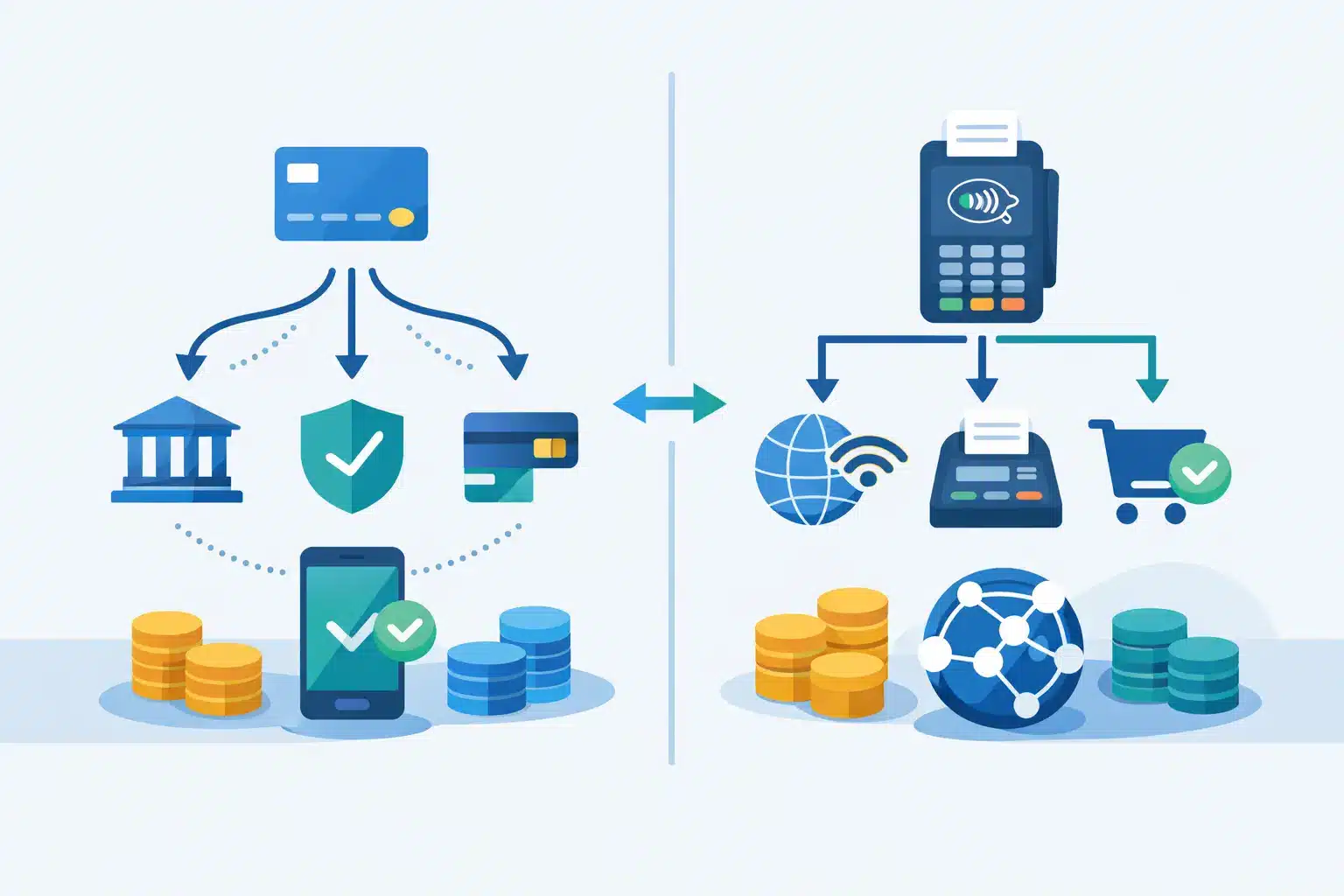
A deposit that fails at the cashier is not simply a lost transaction. For an iGaming operator, it can mean an abandoned registration, a player moving to a competitor, or a support ticket that consumes operational capacity. That is why payment routing versus gateway switching is more than a technical terminology debate. The distinction determines where an operator controls transaction decisions, how quickly it can add local payment methods, and how well its payment stack performs under pressure.
Both capabilities can exist within the same payments architecture. They solve different problems, however, and treating them as interchangeable often creates unnecessary integration work, weakens reporting, and limits control over approval-rate optimization.
Payment Routing Versus Gateway Switching: The Core Difference
Payment routing is the decisioning layer. It determines where a transaction should go based on configured rules, live performance signals, and business constraints. A routing engine may select an acquirer, payment service provider, processing channel, or merchant account based on the player’s market, currency, payment method, transaction value, issuer behavior, historical approval results, or risk profile.
Gateway switching is the connectivity and handoff layer. It receives a payment request and directs it to the appropriate connected gateway, processor, or payment provider. Its central value is abstraction: the gaming platform can use a normalized integration while the switching layer manages differences among external payment endpoints, message formats, authentication requirements, and response handling.
The practical distinction is simple. Switching ensures that a transaction can reach the right external payment connection. Routing decides which connection gives that transaction the strongest probability of approval while meeting commercial, regulatory, and operational requirements.
A switch can apply static rules, such as sending all Brazilian PIX deposits to one provider and all card payments from a specific market to another. A mature routing capability goes further. It can evaluate route performance and apply conditional logic, failover paths, issuer-level preferences, cost parameters, and transaction-level eligibility in near real time.
Why the Difference Matters in iGaming
Payment performance directly affects acquisition, retention, and player trust. Unlike many digital businesses, iGaming operators must support repeated deposits and withdrawals across different player segments, devices, currencies, and regulatory environments. A payment system has to remain responsive during campaign peaks, major sporting events, and high-volume casino activity without compromising security or auditability.
Gateway switching gives operators a practical way to consolidate integrations. Instead of building separate payment flows into the core platform for every processor or alternative payment method, teams can connect through a common payment layer. This reduces dependency on fragmented provider-specific logic and makes it easier to introduce a replacement provider when a market, commercial agreement, or compliance requirement changes.
Payment routing creates the commercial and operational advantage on top of that foundation. If one acquirer experiences elevated declines for a certain card issuer, routing rules can direct eligible transactions through an alternative approved path. If a local payment method is required for conversion in a new jurisdiction, routing can ensure that players see and use the most relevant available option. If a processor’s costs rise above an agreed threshold, rules can account for that without sacrificing player experience.
The goal is not to send every payment to the cheapest provider. The best route depends on the operator’s priorities at that moment: authorization rate, speed, cost, fraud exposure, local coverage, settlement currency, or service availability.
What Gateway Switching Should Deliver
A gateway switch is particularly valuable for operators managing a growing provider estate. It should standardize payment initiation, status updates, callbacks, refunds, withdrawals, and error handling across providers that may all use different APIs and response models.
For technical teams, this means less payment-specific code inside the player account management system, cashier, sportsbook, or casino platform. For operations teams, it creates a more consistent view of transaction states. A deposit should not appear as a different operational object simply because it was processed through a different provider.
A capable switching layer also supports resilience. When an endpoint becomes unavailable, the platform should identify the issue, preserve transaction integrity, and avoid duplicate charges. But resilience requires discipline. Not every failed transaction can be safely retried through another provider. Some failures are final, some are temporary, and some sit in an uncertain state while a provider confirms whether funds were captured.
This is where idempotency controls, transaction references, callback reconciliation, and clear state management become essential. A switch that only forwards requests without managing those realities can create expensive reconciliation problems.
Switching is not automatic approval optimization
It is common to assume that connecting multiple gateways automatically improves payment conversion. It does not. Multiple connections provide optionality, but they do not define the logic for using that optionality intelligently.
Without routing rules, traffic may remain concentrated on a default provider regardless of approval performance. Or it may be distributed in a way that undermines provider economics, duplicates risk checks, or conflicts with market-specific payment requirements. Connectivity is necessary. Decisioning is where payment optimization begins.
What Payment Routing Should Deliver
Payment routing converts a multi-provider setup into an actively managed payment strategy. At a minimum, rules should consider the payment method, country, currency, transaction type, transaction amount, and provider availability. For mature operations, the routing layer can also use BIN ranges, issuer patterns, velocity signals, authorization performance, fraud indicators, and configured commercial limits.
For example, an operator may route card deposits from a particular region to Acquirer A because of stronger issuer coverage, while directing higher-value transactions to Acquirer B due to negotiated risk appetite. A withdrawal may take a different path than a deposit because payout speed and payout-method eligibility matter more than authorization logic.
Smart routing should be explainable. When a payment is directed to a specific provider, operations and compliance teams need to understand why. Black-box decisioning can be difficult to defend in regulated markets, especially when it affects transaction monitoring, player complaints, or provider reconciliation.
Routing policies should also respect the rules of payment schemes, acquiring partners, and local regulations. A failover design that appears commercially attractive may be prohibited by processor agreements or unsuitable for a given transaction type. The right architecture applies optimization within approved routing boundaries rather than forcing transactions through questionable paths.
Build the Architecture Around Control, Not Just Connections
For a new operator, gateway switching may be the immediate priority. It creates a unified integration model and avoids embedding provider-specific workflows across the platform. This is often the right first step when launching across several payment methods or when speed to market matters most.
For an established operator with material transaction volume, payment routing becomes increasingly important. At scale, even a small improvement in approval rate can have a meaningful revenue impact. Equally, a poorly managed route can create hidden costs through failed deposits, support demand, processor concentration, and player churn.
The strongest model combines both layers under a centralized payment orchestration approach. The switch manages integrations and normalized transaction handling. The routing engine applies policy and performance intelligence. The back office provides visibility into provider health, transaction outcomes, settlement status, exceptions, and market-level payment behavior.
This structure also supports controlled expansion. Adding a new local payment provider should not require rebuilding the cashier or rewriting core platform logic. Once the provider is connected through the switching layer, operations teams can define where and when it becomes available through routing and configuration controls.
Questions to Ask Before Selecting a Payment Stack
Decision-makers should look beyond the number of available payment providers. The more relevant question is whether the platform provides control over the full payment lifecycle.
First, confirm how transaction states are normalized across deposits, withdrawals, refunds, chargebacks, and asynchronous payment methods. Second, establish whether routing decisions can be configured by market, method, currency, issuer, amount, and real-time provider status. Third, verify how the architecture prevents duplicate processing during retries and delayed callbacks.
It is also worth testing reporting depth. Payment teams need more than aggregate success rates. They need to compare approval, failure, latency, and exception patterns by provider, payment method, market, issuer, and route. Without this visibility, optimization becomes guesswork.
Finally, assess how payment controls interact with KYC, anti-money laundering workflows, responsible gaming limits, and fraud systems. A payment layer should support these controls, not operate as an isolated technical service. In iGaming, transaction performance and compliance performance are inseparable.
A payment stack should give operators the freedom to add providers while retaining authority over where transactions go and why. Start with reliable switching, build routing policies around verified data, and keep every rule visible to the teams responsible for growth, risk, and player experience.



DiscussionHave a technical perspective or question?Open discussion