

If you’re still integrating game studios one by one, you’re not just adding content – you’re adding operational drag. That is the real answer to why do operators need game aggregation: it gives casino and betting brands a faster, more controlled way to launch, expand, and manage content without building a fragmented supplier network from scratch.
For operators competing on release speed, market coverage, and retention, aggregation is not a nice-to-have layer. It is infrastructure. The value is not only in getting more games live. It is in reducing integration overhead, centralizing content delivery, simplifying commercial management, and creating room to scale without rebuilding the platform every quarter.
Why do operators need game aggregation for growth?
At the commercial level, aggregation solves a simple but expensive problem. Players expect variety. They want top-performing slots, live dealer tables, niche content, crash games, instant wins, and localized titles that match their market. Delivering that breadth through direct integrations alone takes time, internal resources, certification work, compliance coordination, and constant maintenance.
Every direct studio integration introduces a new technical relationship. APIs differ. Game launch methods differ. Promotional mechanics differ. Reporting formats differ. Even when the content itself is attractive, the integration burden can slow down roadmap execution and create unnecessary dependency on internal development teams.
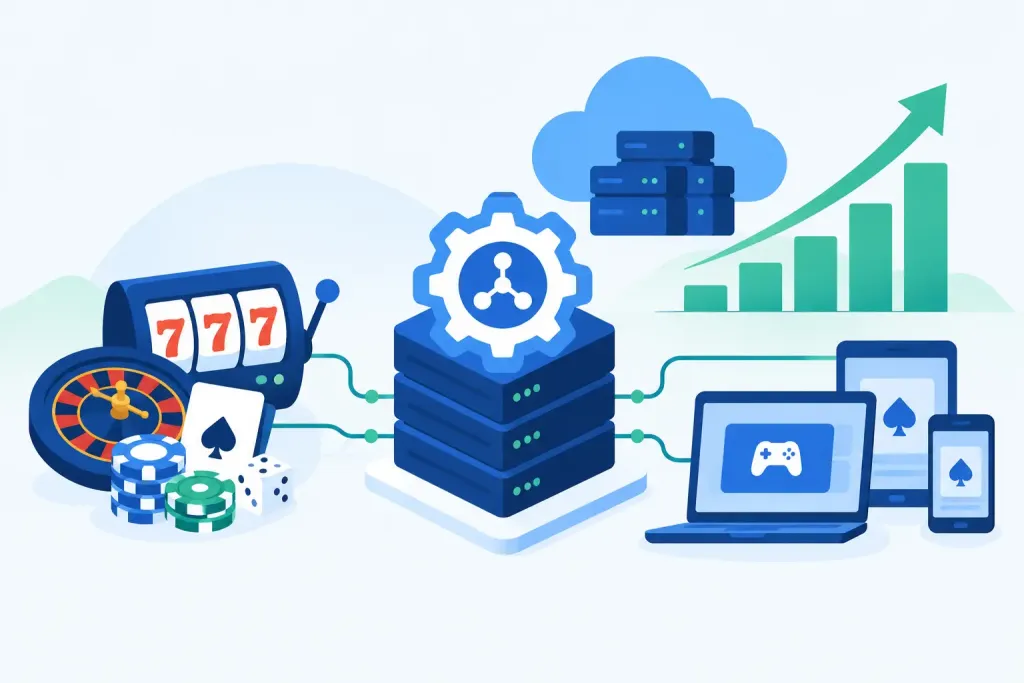
Aggregation changes that model. Instead of managing dozens of separate content pipes, operators access multiple providers through a single technical framework. That reduces time to market and gives product teams more flexibility to respond to player demand.
This matters even more for operators entering new jurisdictions or repositioning an existing casino brand. Content strategy is rarely static. What performs in one market may underperform in another. With an aggregation layer, expanding or adjusting the catalog becomes a commercial decision, not a prolonged development project.
The operational case for game aggregation
The strongest case for aggregation is usually operational, not cosmetic. A larger lobby looks good, but the real gain is in how the business runs behind the front end.
When operators rely on multiple direct integrations, internal teams often spend too much time on vendor coordination, release testing, reconciliation issues, and support escalation. That overhead grows fast. What starts as a manageable content stack can turn into an operational bottleneck as the platform expands.
A strong aggregation model centralizes key functions. Content onboarding becomes more standardized. Game data and availability are easier to manage. Back-office visibility improves. Support processes become more predictable. This reduces friction for product, operations, compliance, and technical teams at the same time.
There is also a commercial control advantage. Operators can test content categories, monitor provider performance, and refine lobby composition with fewer infrastructure constraints. If a provider underdelivers, replacing or supplementing that content is much easier when the underlying delivery model is unified.
Why direct integrations alone rarely scale well
Direct integrations still have a place. For a flagship supplier, exclusive content partner, or a highly strategic commercial arrangement, going direct can make sense. It may offer deeper customization, earlier access to features, or more tailored commercial terms.
But direct-only models become harder to justify as content portfolios grow. Each new supplier increases development complexity and long-term maintenance costs. That affects release velocity across the platform, not just the casino lobby.
This is where many operators run into a hidden issue. They assume the main cost is the initial integration. In reality, the long-term burden is often greater. Version updates, reporting changes, bonus compatibility, game availability issues, jurisdiction-specific restrictions, and incident handling all require ongoing attention.
Aggregation helps contain that complexity. It does not remove every operational challenge, but it consolidates much of the work into a more manageable structure. For leadership teams trying to control cost while increasing platform capability, that trade-off is compelling.
Content breadth is only useful if the delivery is stable
One common mistake is to treat game aggregation as a content marketplace and nothing more. Content access matters, but delivery quality matters just as much. If the aggregation layer introduces latency, inconsistent reporting, poor failover behavior, or weak support processes, the catalog advantage loses value quickly.
Operators need an aggregation setup that performs like core platform infrastructure. That means stable API behavior, consistent uptime, reliable game launch flows, accurate data transfer, and enough technical maturity to support peak traffic conditions.
This is especially important for enterprise brands and high-growth operators. As player volumes increase, small delivery issues become visible fast. Session failures, content outages, and delayed reporting affect both revenue and trust. The right aggregation partner helps reduce those risks by providing a standardized and tested framework for content delivery across providers.
Why do operators need game aggregation in regulated markets?
In regulated environments, aggregation can reduce complexity in a very practical way. Operators still carry the burden of compliance, licensing alignment, responsible gaming obligations, and market-specific operational standards. But working through a structured aggregation environment can simplify how content is introduced and managed.
Jurisdictional content controls, certification requirements, and provider availability can vary significantly across markets. Without aggregation, adapting the content layer for each region may require repeated technical and operational effort. Aggregation creates a more centralized method for handling those differences.
That said, this is not automatic. The quality of the aggregation partner matters. Operators need visibility into what is certified, where each title is available, and how market restrictions are managed. A weak aggregation setup can create confusion. A mature one can improve launch readiness and reduce avoidable compliance friction.
Aggregation supports faster product decisions
Growth in iGaming is not only about adding more games. It is about making better product decisions faster. Which providers retain high-value users? Which game types perform by market? Which releases improve first-time deposit conversion? Which content supports cross-sell from sportsbook to casino?
Aggregation can improve the speed of those decisions when data and content management are centralized. Product teams can compare performance across providers more efficiently and adjust the lobby based on actual results rather than vendor assumptions.
This creates a practical advantage. Operators do not need to lock themselves into a rigid content structure. They can test, refine, and reposition the portfolio with greater agility. In a category where player preferences shift quickly, that flexibility has direct commercial value.
Vendor consolidation is a strategic advantage
Most operators are not trying to build the largest vendor map possible. They are trying to build a business that can scale without becoming harder to run. Vendor consolidation helps with that.
Game aggregation reduces the number of technical connections and support relationships the operator needs to manage directly. That can shorten launch cycles, simplify procurement, reduce maintenance pressure, and improve accountability. Instead of coordinating with a large number of separate suppliers at every stage, teams work through a more centralized framework.
This does not mean every supplier relationship disappears. It means the operator can be more selective about where direct relationships are actually worth the added complexity.
For many brands, this is where the ROI becomes clear. Aggregation is not just about content volume. It is about operational efficiency at scale.
What operators should look for in an aggregation partner
Not all aggregation models solve the same problem. Some are strong on content count but weak on infrastructure. Others provide better technical performance but limited provider depth. Operators need to evaluate aggregation through both a commercial and technical lens.
A capable partner should offer broad and relevant content access, but also strong API architecture, dependable uptime, clear reporting, responsive support, and compatibility with the wider platform environment. If payments, player account systems, promotions, and back-office tools are disconnected from the content layer, the operator may still end up with a fragmented stack.
This is why integrated infrastructure matters. A provider like Gameifylabs positions aggregation as part of a larger deployment framework, not an isolated feature. For operators launching or scaling across multiple markets, that model can reduce implementation risk and improve long-term control.
The best aggregation setup is the one that fits the operator’s actual business stage. A startup brand may prioritize launch speed and broad initial coverage. An established operator may care more about reporting depth, market-specific content, and enterprise stability. The right answer depends on roadmap, geography, and internal technical capacity.
Operators do not win by collecting integrations. They win by building a platform that can ship faster, adapt to demand, and stay stable under pressure. Game aggregation matters because it turns content expansion from a recurring technical burden into a more manageable growth function. If your platform is built to scale, your content strategy should be too.


DiscussionHave a technical perspective or question?Open discussion