

A casino aggregator review should not start with a game count. For an operator preparing to launch or expand, the real question is whether an aggregation partner reduces operational complexity without creating new dependencies, compliance gaps, or performance constraints. A catalog of thousands of titles has limited commercial value if integrations are unstable, reporting is incomplete, and new markets require repeated technical work.
The right aggregator becomes infrastructure: one integration layer that connects content, manages provider relationships, standardizes data, and supports commercial growth. The wrong one becomes another fragmented vendor relationship your product, operations, finance, and compliance teams must constantly manage.
What a Casino Aggregator Actually Delivers
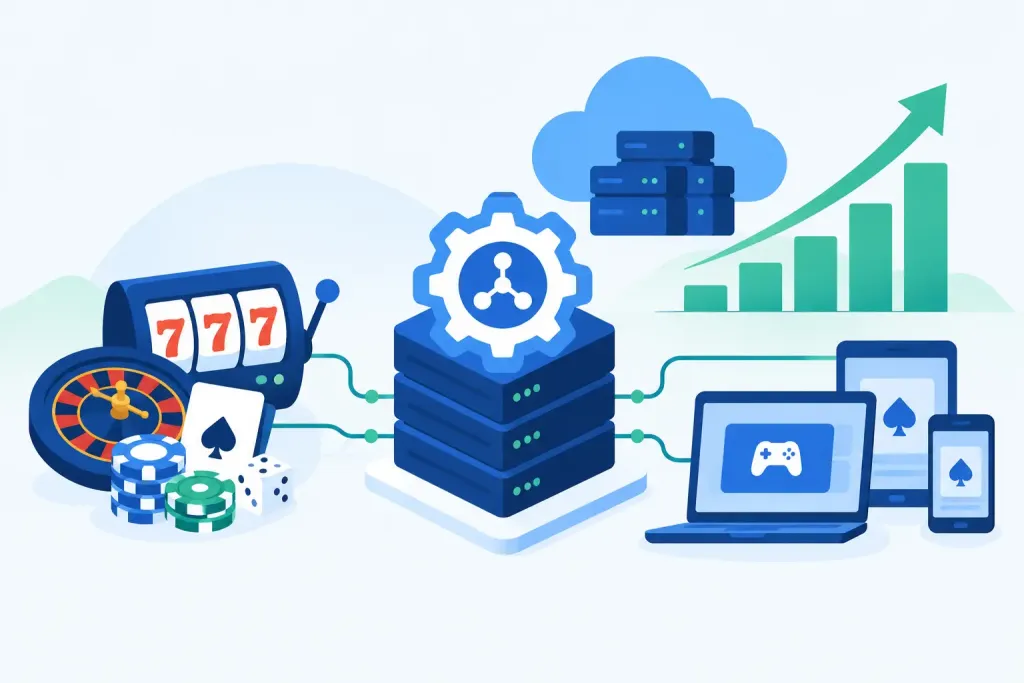
A casino aggregator connects an operator or platform to multiple game providers through a unified API. Instead of building and maintaining separate integrations for slots, live casino, instant games, table games, and specialty content, the operator connects to the aggregator’s technical layer.
That model can materially shorten time to market. It can also centralize game launch controls, content availability, player session behavior, wallet communication, reporting, and promotional configuration. The scope differs by provider, so buyers should avoid assuming that every “single API” offers the same level of operational control.
At a minimum, an enterprise-ready aggregation service should provide dependable game delivery, normalized API documentation, clear launch environments, and a back-office view that gives teams visibility into performance and transactions. The stronger platforms extend this foundation with multi-currency support, wallet flexibility, jurisdictional configuration, player protection controls, and provider-level content management.
Aggregation is not only about adding games. It is about replacing a scattered set of technical and commercial processes with a controlled operating model.
Casino Aggregator Review Criteria That Matter
A productive casino aggregator review evaluates the platform against the operator’s launch plan, technical architecture, and target jurisdictions. A generic feature comparison rarely reveals whether the service will work under real production conditions.
Content quality beats headline volume
Large content libraries are attractive, but raw volume can hide duplication, poor regional relevance, or providers that are unavailable in the markets that matter to your business. Review the portfolio through the lens of your acquisition strategy.
Ask whether the aggregator supports established studios alongside emerging suppliers, whether live casino content is included or separately contracted, and how quickly new releases become available. Evaluate categories individually. A strong slots catalog does not compensate for weak live dealer coverage if your VIP strategy depends on live gaming.
It also depends on the audience. A startup entering one regulated market may need a focused, certified portfolio with recognizable studios. A multi-brand operator may prioritize broad content choice, detailed segmentation, and the ability to differentiate lobbies by region, player value, or brand identity.
API design and integration ownership
The single API promise only matters if the implementation is genuinely standardized. Technical teams should inspect the integration model before commercial terms are finalized. Determine how game sessions are initiated, how balances and bets are exchanged, how round reconciliation works, and how the service handles timeouts, duplicate messages, and failed callbacks.
Wallet architecture deserves close attention. Some aggregators use a transfer wallet model, while others support seamless wallet integration where the operator retains ledger control. Neither is universally better. A transfer wallet can simplify some workflows, but it may introduce reconciliation and reporting considerations. A seamless approach can provide more direct control, but it requires a reliable operator wallet service and disciplined implementation.
Request sandbox access and test failure scenarios, not just successful launches. A polished demo does not prove production resilience. Your engineering team should understand rate limits, retry logic, event handling, versioning practices, and the process for rolling out provider-side changes.
Availability, latency, and operational support
Casino content is a revenue-critical system. A few minutes of interrupted gameplay can create player complaints, reconciliation exposure, and avoidable pressure on support teams. Review service-level commitments, historical uptime where available, monitoring capabilities, and escalation paths.
The key issue is not whether an aggregator claims high availability. It is how it isolates provider incidents, communicates disruptions, and restores service without placing the operator in the dark. Ask whether individual providers can be disabled by market, brand, or lobby while the rest of the casino remains available.
Support structure matters most during launch windows and incident response. Confirm coverage hours, named technical contacts, escalation tiers, and the expected response process for wallet or transaction issues. A partner that responds quickly but cannot provide clear root-cause information still leaves your operations team exposed.
Compliance and market readiness
Content availability is shaped by licensing, certification, and local technical requirements. An aggregator may have a broad global catalog but limited relevance to your immediate jurisdiction. Operators should verify which games, providers, game versions, and features are approved for every target market.
This includes more than supplier licenses. Review data handling, audit logs, responsible gaming configurations, game restrictions, reporting exports, and controls for jurisdictional content blocking. If the platform supports multiple brands or territories, assess whether rules can be configured at the correct level rather than applied across the entire estate.
Compliance responsibilities must be explicit. The aggregator can provide certified technology and market-specific controls, but the operator remains accountable for its own licensing obligations and operating policies. Ambiguity here creates expensive delays when a market launch is already underway.
Commercial Terms Need an Operating Model
Revenue share is only one line in the commercial picture. A complete assessment considers minimum commitments, setup fees, content-specific commercial arrangements, game provider restrictions, promotional costs, currency conversion exposure, and the commercial impact of entering additional markets.
Reporting should make those costs visible. Finance teams need dependable data on gross gaming revenue, stakes, payouts, jackpots, adjustments, provider performance, and settlement timelines. Product teams need game-level performance data that can guide lobby placement, campaigns, and content decisions. If reports require extensive manual reconciliation, the apparent simplicity of aggregation starts to erode.
Clarify ownership and portability as well. If the operator changes aggregator or restructures its platform, what happens to game configuration, historical data, promotional setups, and provider relationships? A long-term technology partner should make the boundaries of the relationship clear from the start.
How to Run the Evaluation
The most effective selection process brings product, technology, operations, compliance, and finance into the same review. Each group sees a different risk, and the decision is weaker when one perspective dominates.
Begin with a practical requirements document based on the next 12 to 24 months. Define launch markets, target player segments, required game categories, expected currencies, wallet model, expected transaction volume, reporting requirements, and expansion priorities. This prevents a provider from winning the evaluation based on capabilities that will not affect your business.
Then require evidence. Review API documentation, sandbox behavior, provider lists by jurisdiction, support procedures, security documentation, sample reports, implementation plans, and contractual service commitments. Where possible, run a limited technical proof of concept that includes real wallet flows, reporting validation, and failure handling.
Finally, score vendors on weighted criteria rather than instinct alone. Content breadth may carry substantial weight for one operator, while a regulated-market entrant may place more weight on certification readiness, documentation, and operational support. The goal is not to find the largest aggregator. It is to find the partner whose architecture and service model fit your operating reality.
Build for Expansion Without Rebuilding
The strongest aggregation strategy supports more than the first launch. As an operator adds brands, jurisdictions, payment methods, and player segments, content controls must remain manageable. This is where a broader platform approach can be valuable: aggregation connected to back-office management, payment infrastructure, player data controls, and a scalable frontend rather than treated as an isolated API.
Gameifylabs approaches iGaming infrastructure with that operational view, combining aggregated content access with platform, payment, and back-office capabilities designed for controlled deployment and growth. For operators, the advantage is not consolidation for its own sake. It is fewer integration points to maintain and clearer accountability across the technology stack.
Choose an aggregator that can support the business you are building next, not merely the game lobby you can launch this quarter. A disciplined evaluation now gives your teams more control when growth, regulation, and player expectations become less forgiving.


DiscussionHave a technical perspective or question?Open discussion